
How to Differentiate a Scientific Problem from a Professional Problem (and Why It Matters in Academic Writing)
By TEXTUM Academic Mentoring
In teacher training and graduate programs, one of the most frequent mistakes appears right at the beginning: confusing a scientific problem with a professional problem. This confusion not only affects the quality of the final work but also distorts the methodological route, the internal coherence of the project, and the evaluation process.
At TEXTUM Academic Mentoring, we help students, teachers, and researchers clarify this distinction from the very first draft. Here is a clear and practical guide to understanding both types of problems—and choosing the right methodological path for each.
1. What is a scientific problem?
A scientific problem is a contradiction or gap within the educational sciences, aimed at explaining, understanding, analyzing, or modeling an educational phenomenon. Its purpose is cognitive and methodological: to generate explanations, models, and insights that strengthen the scientific basis of educational practice and innovation.
It arises from:
Theoretical gaps and academic debates
Conceptual contradictions
The need to explain a phenomenon scientifically
It can be written as a research question or as a declarative statement:
Interrogative form: How does formative feedback influence reading comprehension levels among eighth‑grade students at “La Victoria” Educational Unit?
Declarative form: The influence of formative feedback strategies on the development of reading comprehension levels among eighth-grade students at “La Victoria” Educational Unit.
2. What is a professional problem?
A professional problem is a real, concrete difficulty that emerges in the teacher’s daily practice. Its immediate purpose is to improve, intervene, or transform a specific educational situation.
It arises from:
Classroom diagnosis and observation
Performance analysis and institutional needs
It can be written as a factual situation or as a professional question:
Declarative form: Deficiencies in communicative fluency among eighth‑grade students at “La Victoria” Educational Unit, expressed through timidity when speaking, limited vocabulary, and lack of coherence in spontaneous discourse.
Interrogative form: How can communicative fluency be strengthened among eighth‑grade students at “La Victoria” Educational Unit?
Its purpose is practical and applied: to solve, optimize, and transform.
💡3. The Key Difference You Must Understand
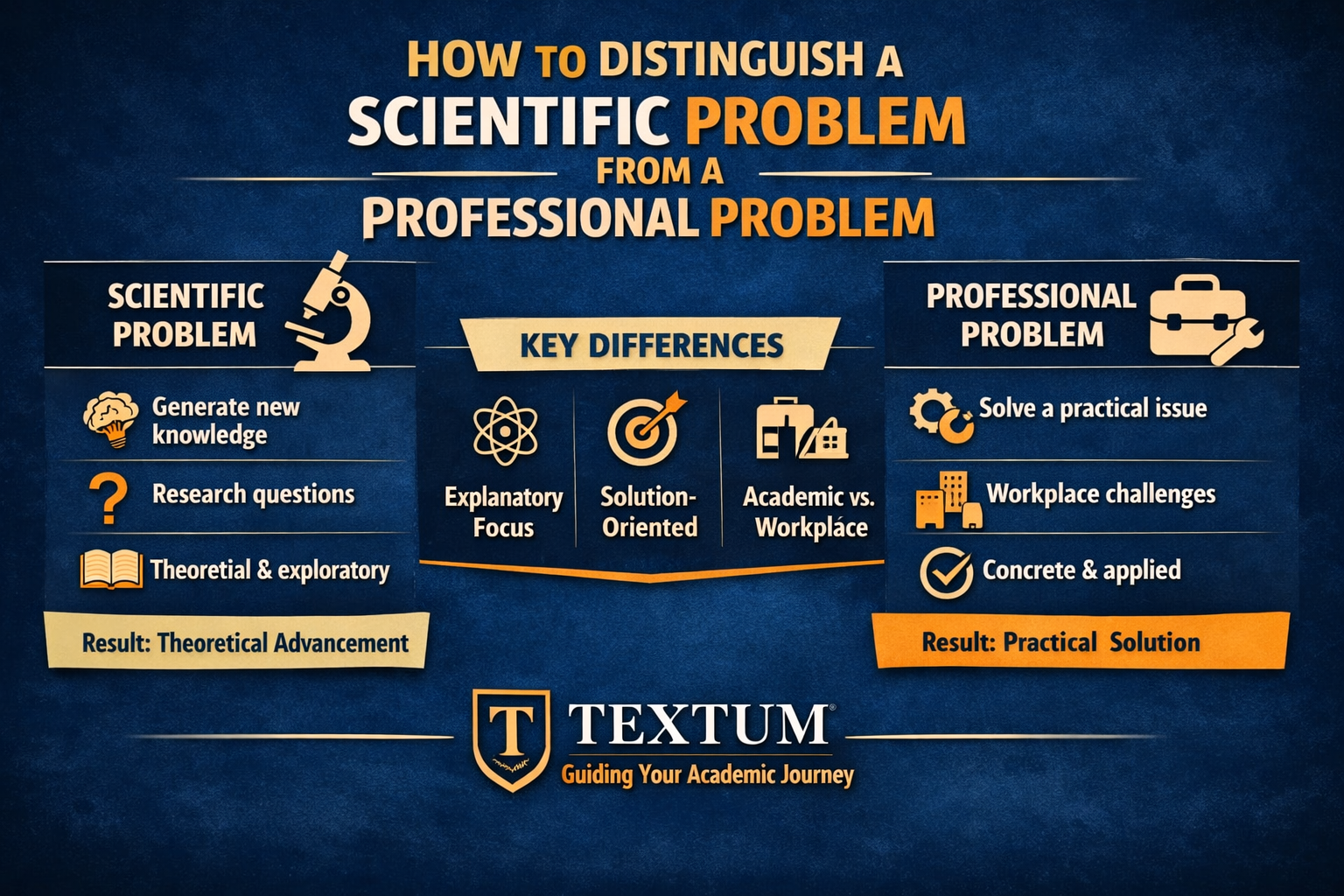
A scientific problem arises from theory; a professional problem arises from diagnosis. The scientific problem seeks to explain; the professional problem seeks to improve. The scientific problem produces knowledge; the professional problem produces solutions.
When this distinction is understood, the entire project becomes more coherent: the objectives, methodology, theoretical framework, and conclusions align seamlessly.
Below is a visual summary that highlights the differences between a scientific and a professional problem, helping you identify the right methodological route for your project. Scientific problem → explains. Professional problem → transforms.
4. Methodological Route for a Scientific Problem
When the problem is scientific, the route follows the logic of pure or applied research:
In‑depth theoretical review: Identify key concepts, theories, and gaps.
Formulate the scientific question: Precise, delimited, and coherent with the theoretical framework.
Research objectives: Aim to explain, correlate, or analyze.
Methodological design: Select approach, study type, techniques, and instruments.
Data analysis: Process data, patterns, and categories.
Discussion: Contrast results with existing theories and studies.
Scientific conclusions: Contribute theoretical‑methodological insights and new research lines.6. Why is this distinction essential in academic writing?
5. Methodological Route for a Professional Problem
When the problem is professional, the route follows the logic of pedagogical intervention and action research:
Context diagnosis: Gather evidence through observation, tests, or surveys.
Identify the problematic situation: Define it based on observable manifestations.
Formulate the professional problem: Present it clearly as a situation or need question.
Applied theoretical foundation: Use conceptual support to justify the proposal—not to generate new theory.
Design the improvement proposal: Develop strategies, activities, resources, and evaluation rubrics.
Implementation (if applicable): Apply the proposal in the classroom, pilot, or simulation.
Evaluation of the proposal: Measure impact through indicators, evidence, and teacher reflection.
Professional conclusions: Systematize achieved changes and practical recommendations.
How to Choose the Right Methodological Route for Your Type of Problem
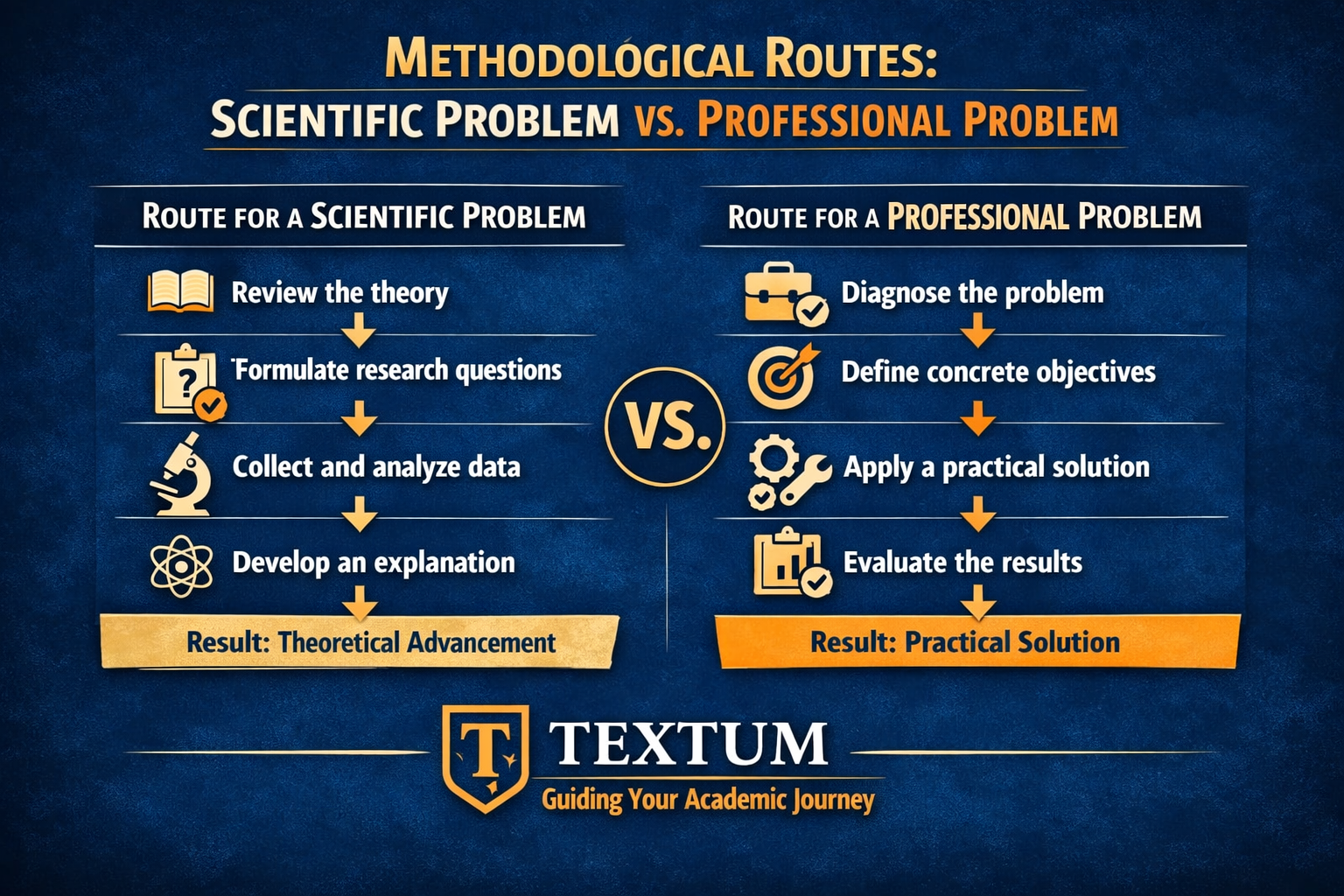
Selecting the appropriate methodological route ensures that your process is coherent, effective, and aligned with the nature of the problem you are addressing—whether scientific or professional.
6. Why This Distinction Is Essential in Academic Writing
This distinction is the backbone of your work; it directly determines the most critical elements of your research:
Methodological design: Prevents you from applying quantitative measurement to a problem that requires practical intervention.
Project structure: Defines whether your text should follow the logic of a theoretical thesis or an innovation project.
Argumentation style: Determines whether your conclusions should contribute new theory or demonstrate a real solution.
Evaluation criteria: Reviewers can detect within minutes whether there is coherence between the problem and the chosen route.
When a student tries to solve a professional problem using a strictly scientific methodology (or vice versa), the project loses strength, becomes confusing, and is often rejected.
At TEXTUM Academic Mentoring, we guide each author to find the right route from the first draft—avoiding rework and strengthening the quality of academic production.
At TEXTUM, we accompany your process.
If you are preparing a research project, a graduate thesis, a scientific article, or your comprehensive exam, we can help you:
Formulate your problem correctly (scientific or professional)
Choose the right methodological route for your degree level
Structure your text with clarity, fluency, and academic rigor
Review and improve your writing according to your university’s standards
Integrate Artificial Intelligence ethically, critically, and transparently
Your text, your voice—crafted with precision and guidance.
👉 [Book your free consultation here]