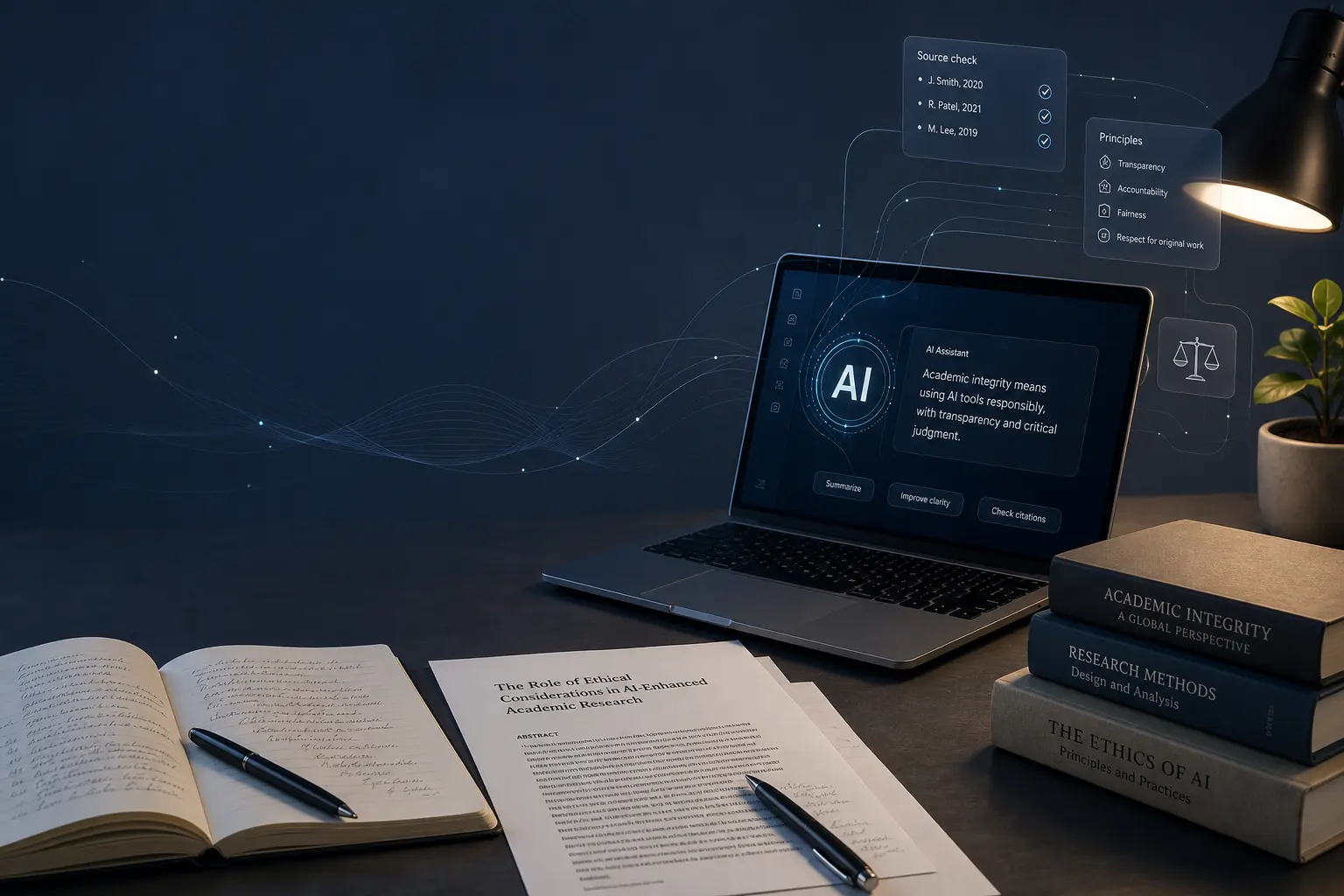
How to use artificial intelligence ethically in your thesis work
ChatGPT is not your enemy (nor your co-author): the methodological keys to using it as an assistant and avoiding rejection of your thesis
By TEXTUM Academic Mentoring
Artificial intelligence is no longer a niche tool in Spanish‑speaking universities: it is part of students' daily lives.
In Latin America, according to data from the Digital Education Council, 92% of university students regularly use at least one AI tool, a figure that exceeds the global average of 86%. In Spain, the landscape is similar: 89% of undergraduate students use generative AI, and 35% use it daily. This phenomenon cuts across all academic levels.
A comparative study involving participants from Argentina, Brazil, Chile, Peru, and Spain shows that graduate students have also integrated ChatGPT into their research and writing processes. However, they do so with only a moderate self‑perceived knowledge and with great caution. The real problem? Most are unaware that they might be crossing serious ethical lines without realizing it… until it is too late.
Your university constantly warns you about plagiarism. Perhaps they have shared a two‑page institutional guide with you. But almost no one explains to you in practical terms where the limits are, mainly because not even the academic committees themselves are entirely clear about them in the face of technology that advances faster than regulations.
The good news is that using AI in your thesis is not wrong; what is wrong is using it without methodological rigor. In this article, we teach you exactly how to turn it into your ethical ally.
What does the "ethical use" of AI in a thesis really mean?
Let us define the concept with methodological precision:
The ethical use of AI in thesis processes involves using tools such as ChatGPT, Claude, or Copilot strictly as support assistants —never as authors—, maintaining complete transparency about their use, manually verifying every piece of generated data, and assuming absolute responsibility for the final content presented.
Generative AI has neither legal nor moral personality, so it can never be credited as the author or co‑author of a research work. Intellectual responsibility lies entirely and exclusively with the human researcher. In short: you are the author; AI is just your virtual laboratory assistant.
The three silent risks you must avoid
The erosion of critical thinking: When the machine goes from structuring ideas to becoming the intellectual author, the thesis student loses the cognitive ability to defend their own work during the oral defense before the committee.
The homogenization of scientific language: Language models tend to standardize texts under the same syntactic patterns. Excessive use of AI eliminates the unique voice, the richness of vocabulary, and the argumentative nuance that characterize a high‑level thesis.
The false sense of technical security: Many students assume that "a touch‑up with AI" is undetectable. However, universities have responded by integrating advanced modules into platforms such as Turnitin, specifically designed to track semantic and probabilistic patterns characteristic of automated text.
Turnitin's AI detector capabilities
Using the AI Writing Report – Turnitin Guides
AI writing detection now available in Turnitin – TELT @ SMP
TELT @ SMP - The Australian National University
Practical guide for ethical and strategic use of AI
A. Methodological transparency
Academic integrity requires declaring the origin of every idea and process. If you use language models to streamline secondary tasks, document this clearly in the methodological section of your research or in an explicit statement in the preliminary pages. Deliberately concealing this is sanctioned by universities as a serious ethical offense.
B. The principle of mandatory verification
AI models suffer from "hallucinations": they invent statistics, create broken web links, and fabricate bibliographic citations by real authors who never wrote those articles. Never submit a paragraph generated by AI without having previously cross‑checked every piece of data against real scientific databases (such as Scopus, Web of Science, or Google Scholar).
C. AI as scaffolding, not as brick
Imagine AI as the scaffolding of a construction: a temporary and external structure that gives you access to higher levels of synthesis, but which is completely removed once the work achieves its own stability.
Permitted and ethical uses: Structuring draft tables of contents, summarizing extensive preliminary readings to identify variables, auditing the grammatical cohesion of your own paragraphs, or brainstorming.
Prohibited and fraudulent uses: Drafting entire chapters, delegating interpretation and analysis of your field data to the machine, substituting your own theoretical argumentation, or falsifying the bibliographic apparatus.
The "VERITAS" Framework for Academic Writing
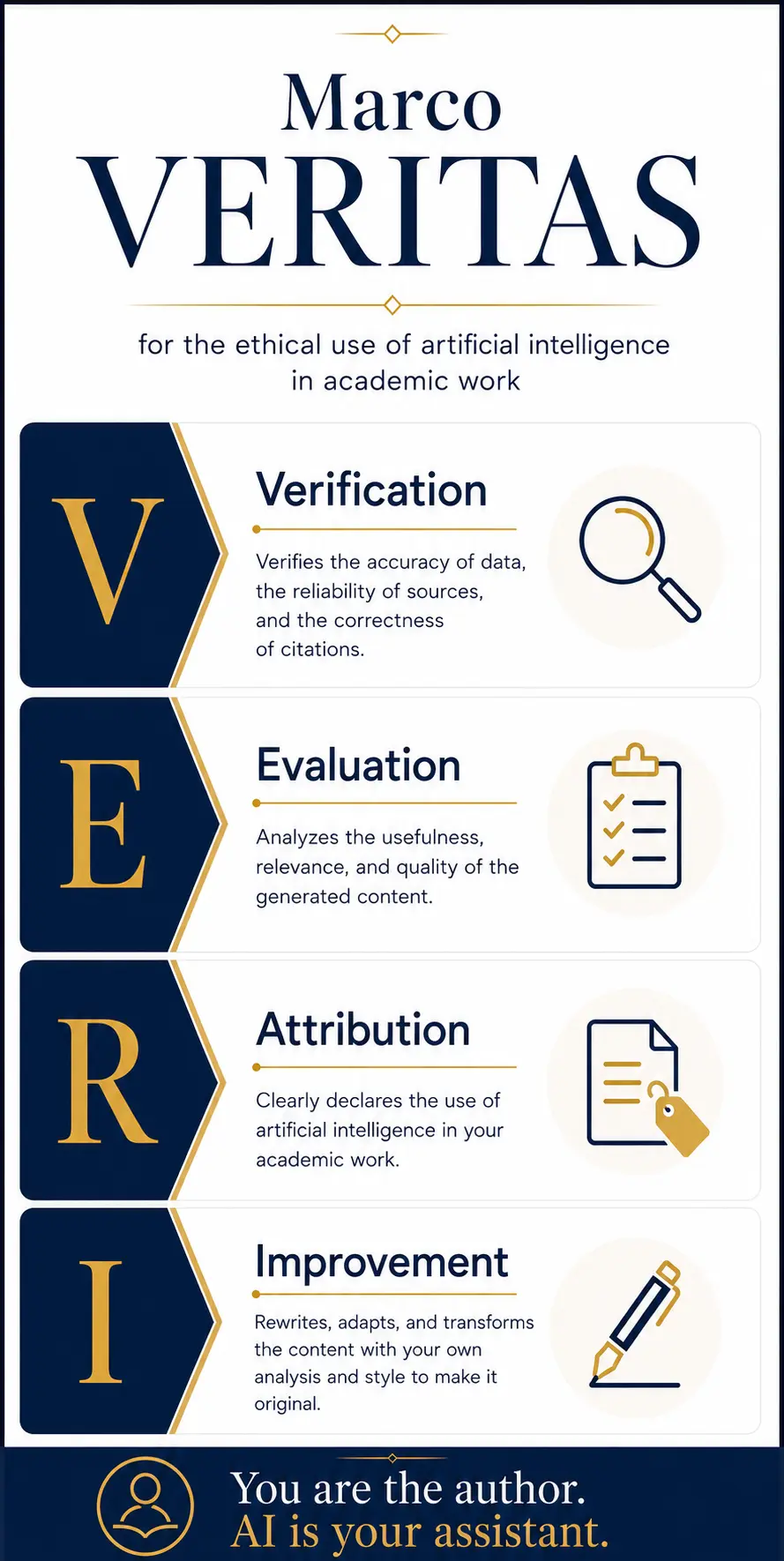
To protect the validity of your thesis work, systematically apply this four‑stage methodological filter before any interaction with AI tools:
Verification: Manually check the truthfulness of every source, date, statistic, or verbatim citation provided by the tool.
Evaluation: Critically analyze whether the conceptual approach suggested by the model possesses the scientific depth required for a graduate level.
Attribution: Openly declare in the methodology section which tool you used, which model version, and for what specific purpose.
Editing: Transform, rewrite, and imbue your own linguistic style into the filtered information to ensure the final text reflects your voice as a researcher.
Quick checklist for the modern researcher
To avoid confusion before submission, self‑evaluate your manuscript under these control parameters:
What IS allowed:
Using language models to organize preliminary content outlines.
Using AI assistants to polish the style and proofreading of your drafts.
Relying on automated tools to optimize semantic searches for specialized literature.
What is NOT allowed under any circumstances:
Copying and pasting direct synthetic text blocks into the development chapters.
Delegating the drafting of conclusions, discussions, or empirical analyses of the project to AI.
Hiding the use of language assistance software from your thesis advisor or institutional tutor.
The current reality of university policies
University regulations in Spain and Latin America are in a permanent state of updating. Guidelines vary drastically not only between countries but also between faculties on the same campus. Some universities, such as the UNED, do not permit AI‑generated content in undergraduate or master's theses unless expressly authorized by the faculty. Our recommendation at TEXTUM is definitive: consult your faculty's explicit policy before structuring your methodology.
Conclusion for the researcher of the future
Artificial intelligence is here to stay, and there is no need to fear it. The real danger is not the software itself, but delegating to an algorithm the capacity to think that belongs to you as a professional.
Technology can help you build the scaffolding of your research, but the foundations, conclusions, and intellectual defense of your thesis must be 100% human. Use AI to enhance your productivity, never to replace your intellect. Choose to research with integrity.
At TEXTUM we teach you to research with comprehensive judgment
At TEXTUM Academic Mentoring, we do not limit ourselves to correcting the surface of your manuscript; we guide you pedagogically so that you use emerging technologies with intellectual maturity and scientific transparency. True success in graduate school does not lie in a perfect document printed by software; it lies in consolidating a researcher capable of defending their ideas with competence.
We align your process under our methodological motto: "From correction to learning."
Do you want to validate whether you are using technology safely in your draft? Book a free, no‑obligation 15‑minute initial diagnostic consultation with our expert team.
👉 [Book your free 15‑minute consultation here]
Frequently Asked Questions (FAQ)
Can I use ChatGPT to draft sections of my thesis?
You may use it exclusively as a secondary assistant to structure drafts or clarify initial conceptual doubts. Never use it to write the body of the research. You must manually verify every piece of data and openly declare its use in the methodological design.What is the proper way to declare the use of AI in the document?
A transparent statement should be inserted within the methodology section or in the preliminary explanatory notes section. A standard example is: "This research process used the Claude 3.5 model as a technological assistance tool exclusively during the stylistic optimization and grammatical auditing phases of the original manuscript."Is it ethical to use automated tools to translate my bibliographic sources?
Yes, it is completely valid to expedite the reading of international literature in other languages. However, it is imperative to carry out a detailed human review of the translated technical terms, since generic software often alters the specific technicalities of each discipline.What should I do if my university strictly prohibits the use of AI?
You must strictly adhere to the principle of institutional legality and refrain from using it. Academic integrity implies respecting the current regulations of the institution that will issue your professional degree.Can I cite an artificial intelligence within my bibliographic references?
No. International citation standards (such as APA 7th edition) stipulate that AI does not qualify as a primary or academic information source. If AI suggests an idea or finding to you, you must trace the original indexed scientific document that supports that fact, read it, and cite the corresponding human author.