How to Defend Your Thesis Before the Examining Board: The 3 Key Minutes of Your Opening Speech
The Verdict of the First 180 Seconds
By Vilma María Pérez Viñas. TEXTUM. Academic Mentoring
The examining board has given you between 15 and 20 minutes to present a research project that took you months or years to develop. The panic is real. However, neuroeducation shows that the first 3 minutes (the opening speech) define the board's psychological predisposition.
During this brief span, the examiners unconsciously determine whether you are the legitimate owner of the knowledge or if you are simply passively memorizing lines. At TEXTUM, we teach you how to own that time with scientific rigor and eloquence.
1. The Engineering of the Oral Script: The Trilogy of the Magnetic Opening
The most common mistake is to begin by reading the entire title from your slide cover verbatim and greeting each member robotically. That bores the board. A magnetic and inbound opening should break the ice directly by addressing the heart of your methodological contradiction.
Structure your first 3 minutes using this framework:
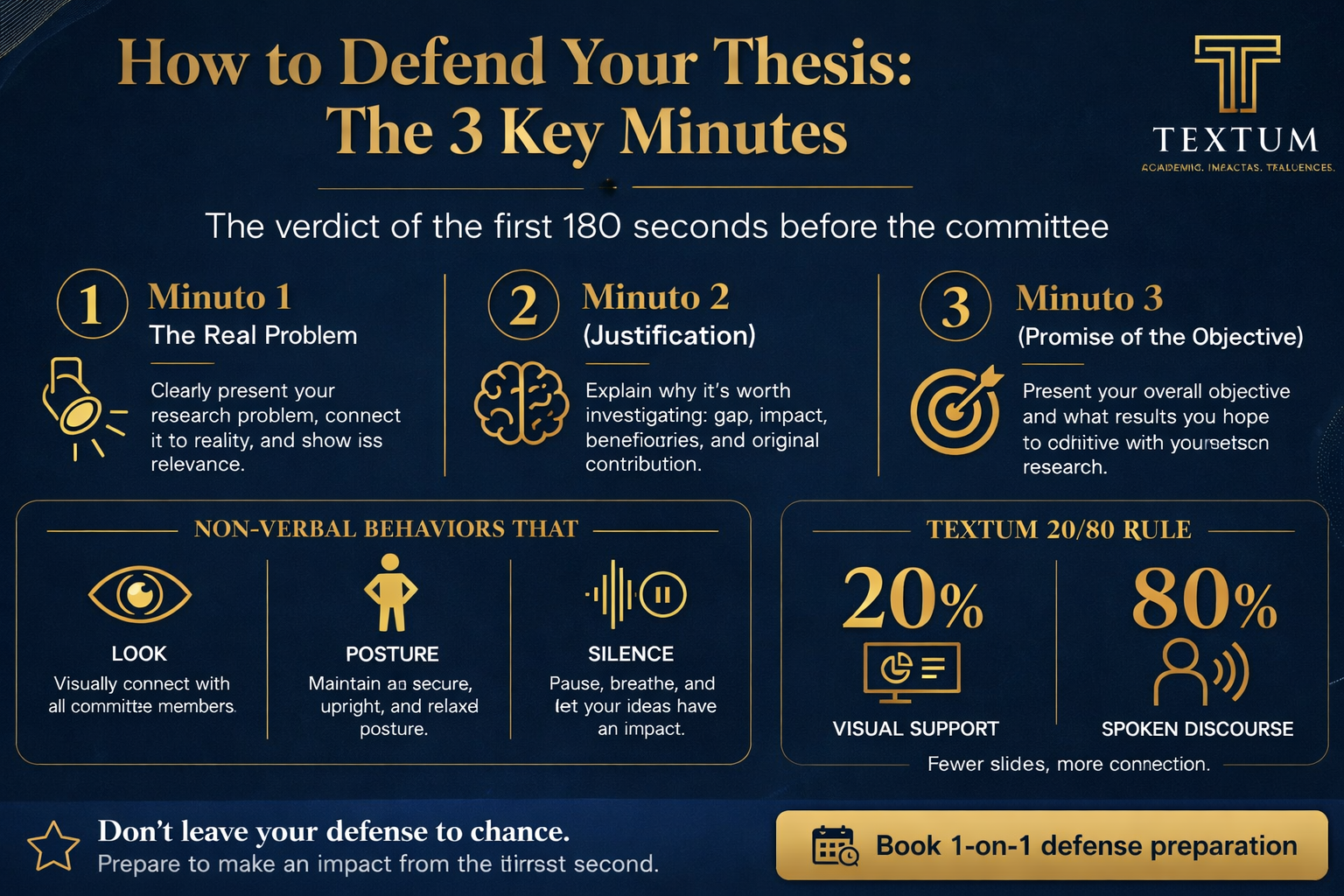
Minute 1: The factual hook (the real problem). Begin by describing the gap or the need for the practice in a compelling way.
Pedagogical example: “Dear members of the board, in current teaching practice, it is often assumed that applying a traditional rubric is sufficient for evaluation. However, the reality in elementary school classrooms demonstrates that this approach generates frustration and hinders active learning...”
Minute 2: The justification and the cognitive gap. Explain why it was a scientific or professional obligation to address this specific situation. This is the moment to demonstrate your methodological mastery.
Minute 3: The promise of the objective. Present your overall goal with a firm voice. Don't say “my work is about”; say “this research provides a surgically designed didactic model for...”
2. Kinesics and Voice Modulation (UDL Principles of Expression)
Under the principles of UDL (Universal Design for Learning), science communication is not limited to the text of your speech; it requires multiple avenues of expression and action. The board evaluates your body language as an indicator of confidence:
The "Z" sweep: Avoid staring at the ceiling, the floor, or exclusively at the board chair. Scan the room in a "Z" pattern. Look each examiner in the eye for three continuous seconds while concluding a thought. This conveys intellectual honesty and disarms any attempt to "trap" you with aggressive questions.
Power posture and open gestures: Keep your back straight, your feet shoulder-width apart, and your arms relaxed. Your hands should move in time with your words, always above waist level. In TEXTUM Philosophy, body language is the organic channel of attraction that prevents the board from losing focus on your value proposition; therefore, you should use it to emphasize key concepts (such as opening your hands when speaking of the "universe" or bringing your fingers together when defining the "sample"). Never cross your arms behind your back or hide them in your pockets.
Managing Methodological Silence: When adrenaline surges, the brain tends to accelerate speech. Force yourself to pause. When you present a crucial statistic or the main result of your proposal, maintain absolute silence for 1.5 seconds. This silence compels the examiners to look up from their papers and focus on you. Well-managed silence is synonymous with authority.
3. The "Silent" Slide Syndrome (Why Reading Verbatim Is Academic Suicide)
If you stand before the board with your back to the room to read the paragraphs of your visual presentation verbatim, your defense is at latent risk. The examiners already know how to read; what they need to evaluate is your ability to analyze, synthesize, and engage in scientific debate.
The TEXTUM Golden Rule: Slides are a visual framework for the audience, not your personal reading notes. Each slide should follow the Inbound Approach of the TEXTUM 20/80 rule: 20% visual support to capture immediate interest and 80% oratorical presentation where you position yourself as the scientific authority on the topic.
Want to rehearse your speech before a live simulated board?
Your successful defense starts today.
Those initial 3 minutes are not a formal greeting; they are the pure application of the TEXTUM Philosophy to the academic environment. You are not there to beg for a grade; you're there to implement an inbound attraction approach where the board validates your scientific rigor and recognizes you as a colleague.
Don't go into the most important day of your career to improvise or just see what happens. At TEXTUM, we offer our 1-on-1 Academic Defense Mentoring.
We don't give you pre-recorded videos: we train you live. We co-create your opening script, technically optimize your slides to meet university standards, and conduct a realistic mock defense using the bank of challenging questions typically used by your faculty. Secure your degree and own the stage!