
The Tower of Babel in Scientific Writing
When More Words Don’t Mean Better Scientific Writing
By Yadyra Piñera Concepción. TEXTUM. Academic Mentoring
At TEXTUM, we support hundreds of researchers, teachers, and students who strive to write with rigor, clarity, and purpose. Yet a phenomenon is increasingly visible in academic writing: terminological inflation. Texts that seem to compete to include the most sophisticated words, the most synonyms, the most neologisms… even when none of that leads to better communication.
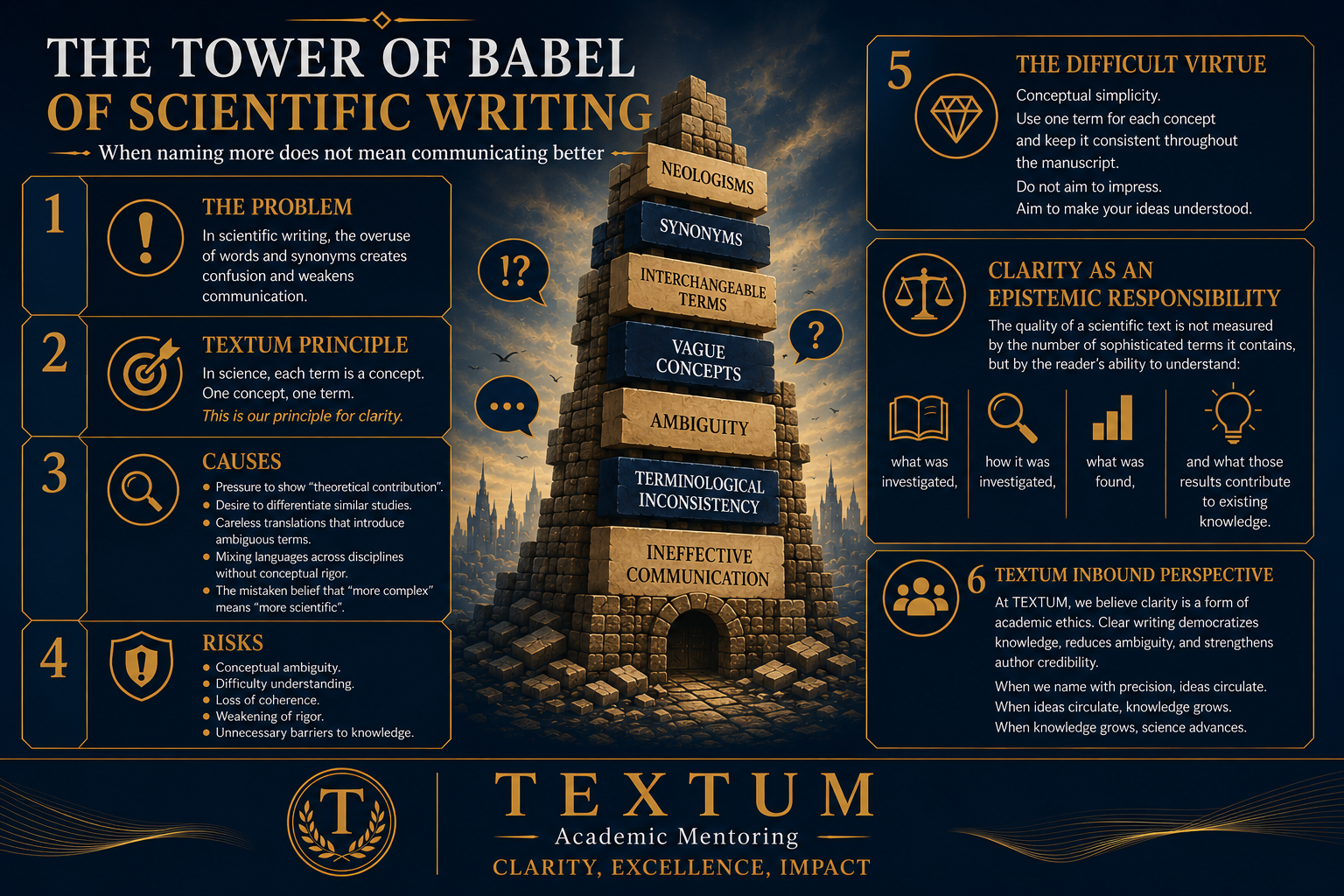
Scientific writing has one essential goal: to make knowledge understandable. When that principle is lost, the text stops fulfilling its epistemological function and becomes a conceptual tower of Babel .
The problem is not the lack of concepts, but the excess of words
In science, every term is a concept. It is not a stylistic ornament; it is a category with boundaries, meaning, and disciplinary consensus. This is why the obsessive search for synonyms—so common in literary or creative writing—can be counterproductive in scientific texts.
“One concept, one term.” (TEXTUM principle for academic clarity)
When an author uses five different labels to refer to the same phenomenon, the reader does not perceive variety; they perceive confusion. They assume new categories are being introduced when only the words are changing.
False novelty: when neologisms replace clarity
New terms constantly appear in the field of education. Some reflect genuine advances in knowledge; others, unfortunately, arise more from the desire to appear innovative than from the need to name a truly new concept.
Science needs new terms only when new phenomena emerge or when existing categories fail to explain reality. What it does not need is renaming well‑defined concepts to create an illusion of originality.
Why does terminological inflation occur?
From TEXTUM’s academic mentoring experience, we observe several recurring causes:
The pressure to show a “theoretical contribution” in every study.
The desire to differentiate works that essentially examine similar problems.
Careless translations that introduce ambiguous terms.
Mixing languages across disciplines without rigorous conceptual review.
The mistaken belief that “more complex” means “more scientific.”
Paradoxically, the opposite is true: the strongest scientific texts are conceptually simple and terminologically precise.
The difficult virtue: conceptual simplicity
The most solid articles share a key characteristic: they use one term per concept and maintain it throughout the manuscript.
They do not seek to impress the reader. They seek to ensure understanding.
Scientific writing does not reward lexical virtuosity. It rewards precision, coherence, and intelligibility. Writing scientifically does not mean complicating what is simple; it means making the complex intelligible.
Clarity as an epistemological responsibility
The quality of a scientific text is not measured by how many sophisticated terms it contains, but by the reader’s ability to understand:
What was investigated,
How it was investigated,
What was found, and
How those results contribute to existing knowledge.
When language becomes unnecessarily complex, knowledge stops circulating. And instead of advancing, science fragments into a conceptual tower of Babel.
TEXTUM Inbound Perspective
Communicate better to research better
At TEXTUM, we uphold a simple premise: clarity is an academic ethic. A clear text not only facilitates understanding; it democratizes access to knowledge, reduces ambiguity, and strengthens the author’s credibility.
Scientific writing does not need more words. It needs better terminological decisions.
When we name with precision, ideas circulate.
When ideas circulate, knowledge grows.
And when knowledge grows, science advances.