
The 5 Methodological Errors That Cause a Thesis to Fail (Even If It's Well-Written)
Discover how to strengthen the methodological coherence of your research before these errors compromise its scientific quality.
It is common for those writing a thesis to dedicate months, or even years, to reviewing literature, drafting chapters, and perfecting their writing. However, when the work reaches the examining board or evaluation committee, the most important observations rarely concern style. They usually focus on methodological aspects that compromise the scientific quality of the research.
A thesis may be correctly written, use appropriate academic language, and present an impeccable formal structure. Even so, it can receive an unfavorable evaluation if the methodological decisions that support it lack coherence.
At TEXTUM, we have found that many of these problems do not originate from a lack of effort on the part of the researcher, but rather from the absence of methodological criteria to guide the construction of the study from its earliest stages. Most errors can be prevented when decisions are based on sound principles and maintain a logical connection throughout the entire research process.
In this article, we analyze five of the most frequent methodological errors that explain why a thesis fails, even when it is well-written.
Error 1. A Poorly Formulated Scientific Problem
Every research project begins with a question.
All research begins with a need for knowledge. The scientific problem is the methodological category that expresses this need and provides the direction that the entire research process will follow.
When the problem is poorly formulated, inconsistencies spread to the rest of the research design. Imprecise objectives, irrelevant methods, and conclusions that do not truly address the scientific need that gave rise to the study emerge.
One of the most frequent errors is confusing the scientific problem with the solution that is subsequently proposed. Instead of investigating the phenomenon that requires understanding or transformation, the researcher formulates the problem around a program, a strategy, a model, or some other previously selected intervention.
Case Study
Problem Situation:
Deficiencies have been identified in the English writing skills of first-year Foreign Language students.
Research Problem Formulated by the Researcher:
How can strategic English writing training be designed to contribute to the text writing skills of first-year Foreign Language students?
TEXTUM ANALYSIS
This approach presents several methodological inconsistencies.
· There is no correspondence between the problem situation and the research problem. The identified difficulty is related to text writing; however, the problem focuses on the design of strategic training, which constitutes a possible solution and not the phenomenon requiring investigation.
· The solution appears to be incorporated from the outset. By asking how to design strategic training, the researcher conditions the study toward a pre-selected intervention.
· The scientific contradiction that justifies the study is not made explicit. The problem should arise from the tension between a need identified in practice and the existing shortcomings in understanding or transforming it.
· The methodological directionality of the research is broken. The process ceases to be organized around the scientific need and begins to revolve around a pre-assumed solution.
TEXTUM CRITERION
In methodologically coherent research, the intervention is a result of the research process, not its starting point.
TEXTUM PROPOSAL
A more methodologically consistent formulation could be:
How can we foster the development of English writing skills in first-year Foreign Language students from a strategic perspective?
Or even:
How can we contribute to the development of English writing skills in first-year Foreign Language students?
In both cases, the problem remains centered on the scientific need. The decision to subsequently develop training, a program, a model, or any other intervention must be justified as a result of the research and not incorporated into its formulation beforehand.
TEXTUM CRITERION
The essential point is not the presence of two variables, but rather that the intervention does not replace the phenomenon that requires understanding or transformation. When the problem is formulated around the design of a strategy, a program, or a model, it ceases to express the investigative need and begins to focus on the construction of the solution.
A Methodological Clarification
After years of reviewing master's and doctoral theses, we have identified an error that is rarely explicitly explained.
In research aimed at transforming practice, it is possible to recognize two complementary dimensions of the research object:
• The transformation dimension, which represents the educational, social, or professional reality that needs to be understood or transformed.
• The intervention dimension, constituted by the proposal that the researcher develops to produce that transformation.
Confusing these two dimensions leads to one of the most frequent methodological errors: formulating the scientific problem around the intervention and not around the scientific need that justifies it.
This distinction also has consequences for the construction of the theoretical framework, whose organization can respond to both dimensions when the nature of the research so requires.
TEXTUM REFLECTION
All research begins long before applying methods or collecting data. It begins when the researcher clearly identifies what needs to be understood or transformed. The quality of research depends largely on the quality of the scientific problem that guides it.
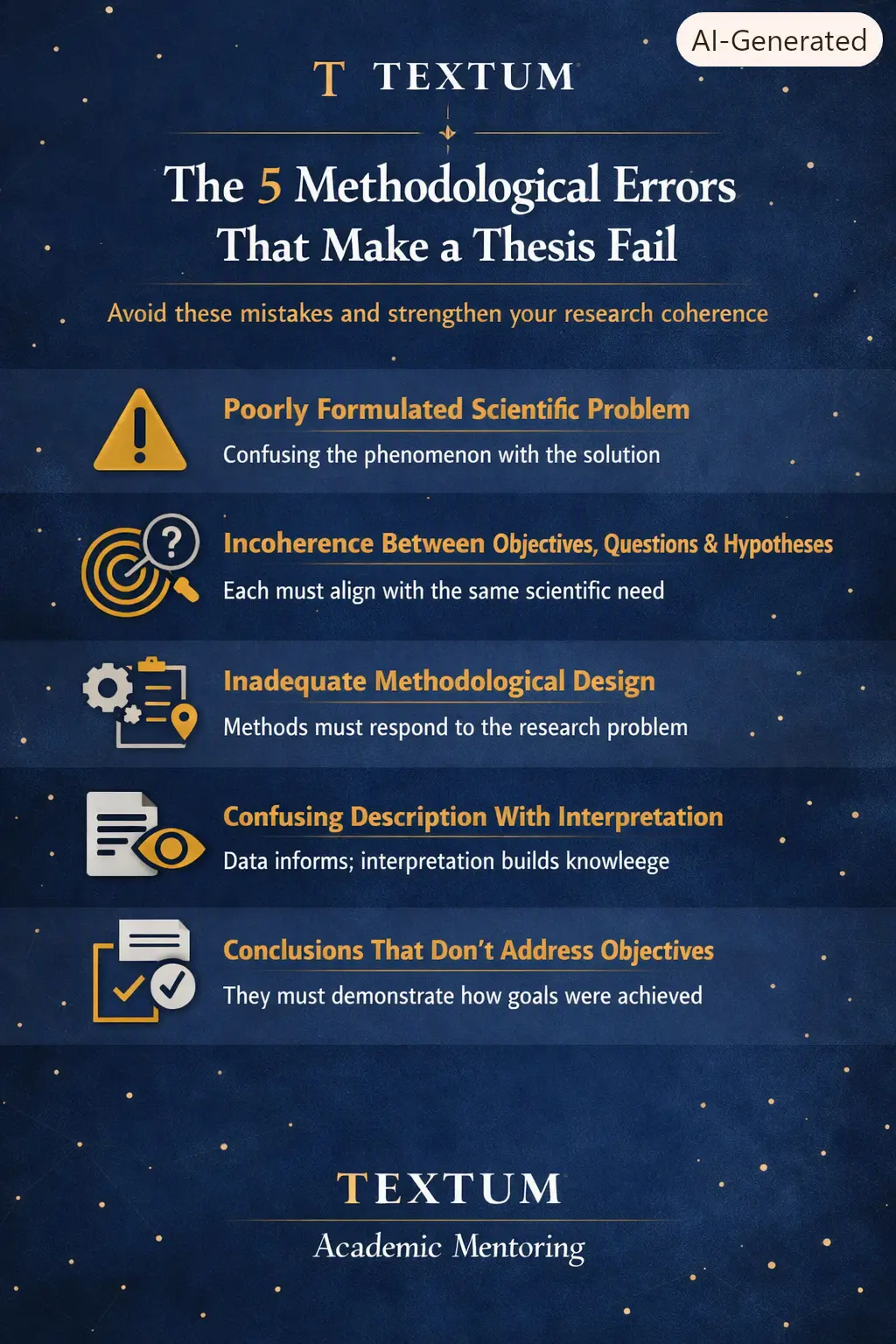
Error 2. Incoherence Between Objectives, Questions, and Hypotheses
Once the scientific problem has been formulated, the next step is to construct a coherent theoretical design.
Each category fulfills a specific function, but none can be developed independently. The scientific problem guides the research; the objectives express the intended results; the questions specify the aspects that must be answered; and, when appropriate, the hypotheses anticipate possible explanations that will be tested.
One of the most frequent methodological errors is to write each category separately, without verifying whether they all address the same scientific need. As a result, the research loses internal coherence, and its different components advance in different directions.
Case Study
Research Problem
How can we contribute to developing argumentative competence in Spanish and Literature students?
General Objective
To design a didactic strategy to develop academic writing skills in students of the Spanish and Literature program.
Hypothesis
The use of cooperative learning improves the motivation of students of the Spanish and Literature program.
TEXTUM ANALYSIS
Although each category is correctly written independently, the whole lacks methodological coherence.
• The research problem focuses on argumentative competence.
• The objective is oriented toward academic writing.
• The hypothesis studies motivation.
Consequently, the research addresses three distinct phenomena; the difficulty lies not in the wording of each category, but in the absence of a logical relationship between them.
TEXTUM CRITERION
The categories of theoretical design constitute a system. Each one derives from the previous one and guides the next. When this relationship is broken, the research loses methodological coherence.
TEXTUM PROPOSAL
Before advancing in the research, review each category by formulating a simple question:
Does this objective, this question, or this hypothesis truly contribute to answering the posed scientific problem?
If the answer is no, the category must be reformulated before continuing.
TEXTUM REFLECTION
Methodological coherence does not depend on each category being correctly worded, but rather on all of them forming part of the same scientific reasoning.
Error 3. A Methodological Design That Does Not Address the Scientific Problem.
Once the scientific problem has been defined, the researcher must select the methods, techniques, and instruments that allow them to understand or solve it.
However, one of the most frequent errors consists of choosing the methodological design based on tradition, convenience, or personal preference, without analyzing whether it is truly relevant to answering the posed problem.
Methodological quality does not depend on applying complex procedures, but on selecting those that generate the information necessary to produce the knowledge that the research requires.
Case Study
Research Problem:
How to foster the development of argumentative competence in students of the Spanish and Literature program?
Methodology
A closed-ended survey was administered at the end of the course.
TEXTUM ANALYSIS
Although the research problem addresses a need related to developing a specific competence, the methodological design remains limited to collecting final opinions through a survey.
This methodological approach makes it difficult to understand how the competence develops, identify the factors that influence it, or assess the processes involved in its transformation.
The difficulty lies not in the survey as a research technique, but in its inadequacy to generate the information required by the research problem.
TEXTUM CRITERION
Methodological relevance does not depend on the prestige or complexity of the methodological design, but rather on the coherence between the scientific problem and the methods, techniques, and instruments selected to obtain the information the research requires.
TEXTUM PROPOSAL
Before defining the methodological design, formulate a fundamental question:
Will the selected methods, techniques, and instruments allow you to obtain the information necessary to answer the scientific problem?
If the answer is negative or raises doubts, it is necessary to rethink the methodological design before beginning data collection.
TEXTUM REFLECTION
Rigorous research is not distinguished by applying more methods, but by selecting those that are relevant to understanding the phenomenon under study and providing a well-founded answer to the scientific problem.
Error 4. Confusing the Description of Results With Their Interpretation
Obtaining data does not mean generating knowledge.
One of the most frequent methodological errors is presenting tables, percentages, or direct quotes as if their mere presentation constituted a scientific analysis.
Interpretation requires going beyond description. It involves explaining the meaning of the results, establishing relationships between them, comparing them with the theoretical framework, and evaluating their contribution to answering the scientific problem.
Case Study
Presented Result:
"72% of the students reported having improved their ability to write argumentative texts."
TEXTUM ANALYSIS
The result reports on a perception of the students but does not explain its meaning from a scientific point of view.
The research describes a piece of data but does not analyze why it occurred, how it relates to the scientific problem, or what it contributes to existing knowledge.
Consequently, the reader knows the result but is unaware of its true interpretive value.
TEXTUM CRITERION
Data constitutes evidence. Scientific knowledge arises when the researcher interprets this evidence in light of the scientific problem, the theoretical framework, and the research context.
TEXTUM PROPOSAL
After presenting each result, ask yourself:
• What does this finding mean?
• How does it contribute to answering the scientific problem?
• What is its relationship to the theoretical framework?
• What does it contribute compared to previous research?
Answering these questions transforms information into scientifically grounded knowledge.
TEXTUM REFLECTION
Describing data is reporting. Interpreting it is building knowledge. The difference between these two actions largely determines the scientific depth of a research project.
Scientific interpretation constitutes the bridge between empirical evidence and the construction of knowledge.
Error 5. Conclusions That Do Not Address the Research Objectives
Conclusions represent the moment when the research demonstrates whether it has fulfilled its purpose.
However, one of the most frequent methodological errors is using them as a summary of the results or activities carried out, instead of demonstrating how the research addressed the scientific problem and achieved the proposed objectives.
A scientific conclusion does not repeat information. It integrates the findings obtained and demonstrates the knowledge constructed during the research process.
Case study
General objective
To design a teaching strategy to promote the development of argumentative competence in students of the Spanish and Literature program.
Conclusion
The students significantly improved their performance during the intervention.
TEXTUM ANALYSIS
The conclusion reports on an observed result but does not demonstrate whether the general objective was achieved.
The reader knows that student performance improved but remains unaware of what can be concluded about the designed teaching strategy—the central purpose of the study. Consequently, a disconnect occurs between the research objectives and its final conclusions.
TEXTUM CRITERION
The conclusions constitute the final proof of methodological coherence. Each one must address the research objectives and, together, demonstrate the answer to the scientific problem.
TEXTUM PROPOSAL
Before writing the conclusions, verify the coherence of the study using a simple matrix that relates:
• Scientific problem.
• Objectives.
• Results.
• Conclusions.
If any objective remains unanswered or any conclusion cannot be linked to the results obtained, it will be necessary to review the methodological coherence of the research.
TEXTUM REFLECTION
The conclusions do not close a research project; they demonstrate whether the methodological approach allowed for a well-founded answer to the scientific problem that gave rise to the study.
Beyond Methodological Errors
The errors analyzed in this article highlight a fundamental idea: methodological difficulties do not usually arise from a lack of knowledge of research techniques, but rather from the absence of principles to guide decision-making throughout the entire research process.
TEXTUM FINAL REFLECTION
Rigorous research is not distinguished by the absence of errors, but by the soundness of the methodological decisions that underpin it.
Research is not simply about answering questions. It consists, above all, of learning to formulate them correctly and making consistent methodological decisions throughout the entire research process.