
Academic Mentoring vs. Traditional Editing: Which One Do You Really Need?
The difference between receiving a corrected text and becoming a competent author.
By TEXTUM Academic Mentoring
"Can you just proofread my thesis? I don't need you to explain anything, I just want it to look right."
We have heard this sentence many times at TEXTUM. And we understand it perfectly. When you are overwhelmed by a deadline, the last thing you want is to "learn". You want the problem to disappear, submit the manuscript, and forget about the stress.
But let us ask you an uncomfortable question: what if the correction you receive today does not prepare you for your next text? What if, a few months from now, you repeat the same mistakes, feel the same anxiety, and pay once more for a review that taught you nothing? Even worse: what if, in a few weeks, you must defend your thesis before a panel and discover that you do not fully understand the changes made to your own document?
That is the thin line that separates traditional proofreading from academic mentoring. They are not the same thing, and here is why.
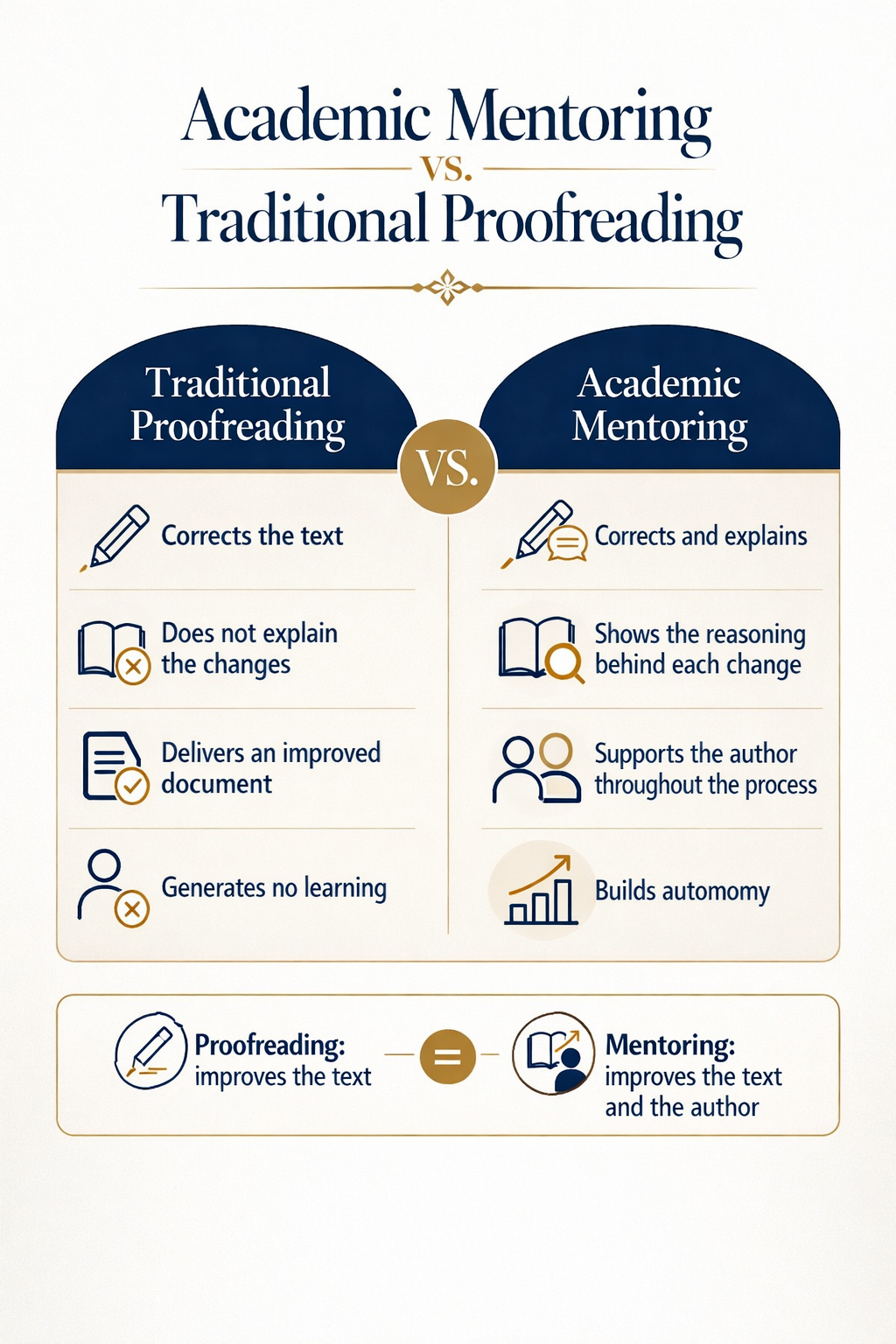
Below is a quick visual summary of the key differences between academic mentoring and traditional proofreading.
1. What is traditional proofreading?
Traditional proofreading is the most common model on the market. It operates under a simple transactional logic:
You send your manuscript.
A professional reviews it (spelling, grammar, and APA/Chicago formatting).
You receive the corrected document.
And that’s it. You don’t know why a word was changed or why an entire paragraph was restructured. You don’t acquire tools to avoid the same pitfalls in your next written work.
Advantages: It is fast, straightforward, and budget‑friendly.
Disadvantages: It generates no learning, you carry the same conceptual errors into future texts, and you become permanently dependent on third parties. If the proofreader does not justify their choices, you will never know whether a change was normative or simply stylistic.
In short: traditional proofreading improves your text.
But you, as an author or researcher, remain exactly where you started.
2. What is academic mentoring?
Academic mentoring is the comprehensive model we practice and advocate for at TEXTUM. Its dynamic is pedagogical and collaborative:
We thoroughly analyze your text.
We correct formal aspects, and we explain the reasoning behind every substantive change.
We deliver a personalized pedagogical report with your recurring error patterns and their technical solutions.
We design 1:1 mentoring sessions to resolve your questions in real time.
You learn —and your next article or chapter will be significantly better without needing to outsource the service again.
Advantages: You develop scientific writing skills, correct writing habits at their root, gain research autonomy, and approach your thesis defense with full methodological confidence.
Disadvantages: It requires deeper involvement and a slightly higher investment.
3. The key difference you need to understand
To choose wisely, analyze how each service impacts the essential elements of your written work:
Central Objective
Traditional proofreading: deliver a document free of formal and typographical errors.
Academic mentoring: develop your competencies as a researcher and author.
Result Obtained
Traditional proofreading: A clean manuscript, ready for submission.
Academic mentoring: An optimal manuscript plus scientific autonomy.
Type of Feedback
Traditional proofreading: Brief, automated, or non-existent comments.
Academic mentoring: A personalized pedagogical report with error patterns and practical solutions.
Work Dynamic
Traditional proofreading: transactional and one-directional.
Academic mentoring: strategic and collaborative through 1:1 sessions.
Future Autonomy
Traditional proofreading: you remain dependent on external editors.
Academic mentoring: you learn to identify your recurring issues and write confidently on your own.
The verdict is simple:
Traditional proofreading improves your text.
Academic mentoring improves you.
4. Which service do you really need?
The answer depends entirely on your professional stage and goals. At TEXTUM, we tailor our support to your priorities:
Traditional proofreading is ideal if:
You urgently need a clean, formatted text for immediate submission.
You do not need to understand the linguistic or methodological reasons behind the changes.
You have a very limited budget.
You are certain you will not produce more academic texts in your career.
Academic mentoring is ideal if:
You want to understand the logic behind your writing errors in order to eliminate them permanently.
You expect to produce more scientific work soon (indexed articles, master’s theses, doctoral research).
You value applied knowledge and want to defend your academic position with solid arguments before a committee.
5. The decision that shapes your graduate experience
Paying not to learn often becomes, ironically, one of the most expensive decisions in academic life. Six months from now, when you face a new article, a degree completion comprehensive exam, or a conference presentation, you could experience the same anxiety —and pay again for a service that did not build lasting skills.
Investing in mentoring today is saving time, resources, and stress tomorrow. It’s not a logistical expense; it’s a quality leap in your profile as a researcher.
Are you ready to transform the way you write? At TEXTUM, we explain every change and prepare you for academic success under our guiding principle: "From proofreading to learning."
Book your free 15‑minute diagnostic session to evaluate your manuscript—no obligation.
6. Frequently Asked Questions (FAQ)
What is the cost of the services?
We offer options for every need: basic formatting corrections starting at $150 USD, and premium mentoring programs with personalized 1:1 sessions starting at $250 USD.How long does a mentoring session last?
Sessions range from 20 to 60 minutes, depending on the methodological package.In which languages do you offer mentorings?
We work with academic texts written in Spanish and English.Is the service limited to degree completion comprehensive exams or theses?
No. We offer specialized support for scientific articles, doctoral theses, undergraduate theses (TFG), master’s theses (TFM), and high-complexity academic essays.Can I hire only style proofreading?
Yes. You can choose our basic proofreading level without the pedagogical component. However, we always recommend experiencing mentoring at least once—you will notice the difference.What if I don’t want to learn, I just want the text corrected?
Then the basic level is perfect for you. But if you ever change your mind and want to strengthen your writing skills, we will be here to support you.
Conclusion to remember
Traditional proofreading is like taking your car to the mechanic: you pay, they fix the issue, and you leave —still not knowing how to change a tire yourself.
Academic mentoring, on the other hand, is like an advanced driving course: it not only helps you reach your current destination safely, but also equips you to navigate every bump on future journeys. Both paths clean up your text, but only one makes you an autonomous professional.
Choose strategically.