
Numbers and Shades: The Comprehensive Research Approach (CRA) in Educational Research
Beyond Approaches: Understanding Reality as a Whole
In educational research, interrogative pronouns—how many, when, what, how, why, and for what purpose—are not simply words. They constitute different gateways to knowledge. Each allows us to explore a specific dimension of the phenomenon we are investigating, and together they reveal a much richer reality than any single perspective could offer.
For decades, research has tended to classify studies as quantitative or qualitative, as if the researcher had to choose between measuring reality or understanding it. However, educational phenomena are not fragmented. They encompass facts, experiences, meanings, relationships, and evidence that form part of the same reality.
The Comprehensive Research Approach (CRA) stems precisely from this conviction: viewing research as a process that bridges different ways of approaching knowledge to more accurately reflect the complexity of educational phenomena.
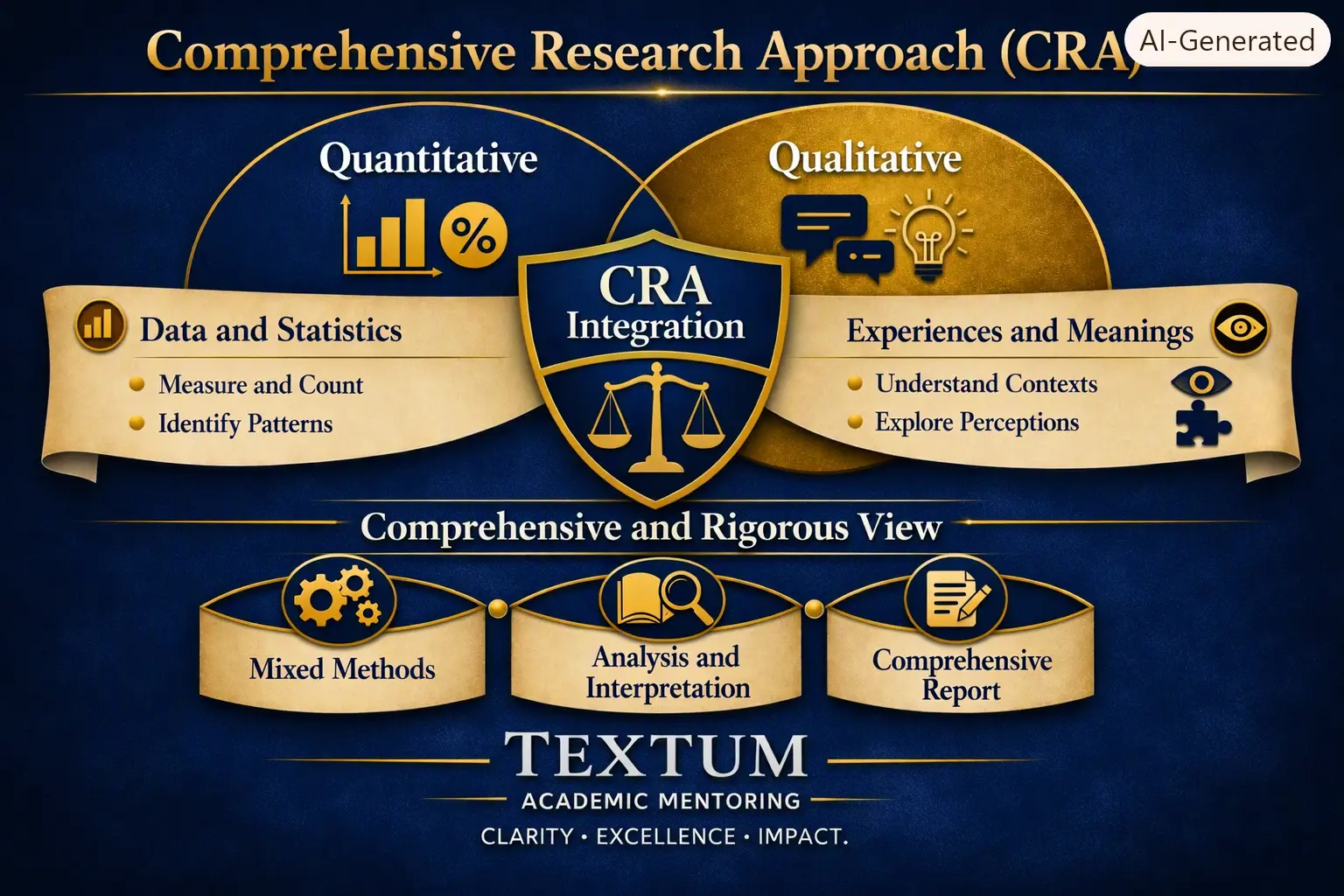
The Duality that Enriches Knowledge
Quantitative research provides precision. It allows us to measure, compare, identify trends, test hypotheses, and estimate the magnitude of phenomena.
Qualitative research provides depth. It facilitates understanding meanings, interpreting experiences, exploring perceptions, and explaining how people construct meaning in the contexts where they act.
Both perspectives offer different answers to equally necessary questions. Neither, on its own, exhausts the reality it seeks to study.
The Comprehensive Research Approach does not propose replacing one approach with the other or using them independently. It proposes understanding that both constitute complementary ways of approaching the same phenomenon. Integration begins with the formulation of the scientific problem and accompanies the entire research process.
From Data to Meaning: An Educational Example
Imagine a study on reading motivation in elementary school children.
From a qualitative perspective, the researcher can explore how students experience reading, what emotions it evokes, what their interests are, and what factors encourage or hinder their participation.
From a quantitative perspective, they can measure reading frequency, the number of books read, the time spent on this activity, or the changes observed after an educational intervention.
Each perspective provides valuable information.
If we only quantify how many children read, we will know the magnitude of the phenomenon, but we will hardly understand the reasons behind their behavior. If we only explore their experiences, we will gain a deep understanding of their perceptions, although it will be more complex to assess the extent of these trends within the studied group.
When both perspectives engage in dialogue, data acquires meaning, and interpretations find support in verifiable evidence.
Thinking about Research Comprehensively
The Comprehensive Research Approach transcends the choice of techniques or methodological procedures. It represents a way of thinking about research.
Integration does not occur solely during the analysis of results. It begins when the researcher formulates questions capable of revealing the complexity of the phenomenon, continues during the construction of the methodological design, and is maintained in the interpretation, scientific writing, and communication of knowledge.
From this perspective, research means building a progressive understanding of reality, articulating different sources of information and various ways of generating evidence to coherently answer the scientific problem.
Balance in the Scientific Report
The Comprehensive Research Approach also guides how research is communicated. A comprehensive scientific report combines interpretive narratives with verifiable data. Tables, graphs, and percentages engage with descriptions, testimonies, and the researcher's reflections. Quantitative evidence strengthens qualitative interpretations, while these, in turn, give meaning to the data obtained.
In this way, the report ceases to present fragmented information and becomes a coherent representation of the research process.
From Confrontation to Complementarity
Educational reality is neither exclusively quantitative nor exclusively qualitative. It is both at the same time.
Numbers make trends visible; shades allow us to understand the meanings that these trends acquire for the people and contexts in which they occur.
The Comprehensive Research Approach proposes abandoning the logic of confrontation to move toward a broader understanding of scientific knowledge, in which different ways of producing evidence complement each other to explain the same reality.
TEXTUM Perspective
At TEXTUM, we understand that research is not about choosing between numbers or meanings. It's about learning to understand reality in all its complexity.
The Comprehensive Research Approach (CRA) is not simply a way of combining methodological perspectives. It constitutes a way of thinking about the research process as a coherent journey that articulates diagnosis, methodological architecture, the generation and interpretation of evidence, scientific writing, publication, and the defense of results.
Because when data engages with experiences and evidence is integrated with interpretation, research ceases to be a mere description of the world and becomes a tool for understanding and transformation.