
Imagine going to a doctor who prescribes medication without telling you what it’s for, how to take it, or what side effects it may have. You buy it, you take it, and you trust blindly. Would you feel safe? Would you truly trust that professional? Probably not.
Yet in graduate‑level writing, we often do something very similar: we submit a graduation project or an article to a traditional proofreader who returns the document full of tracked changes… without a single explanation to justify those modifications.
You don’t know why a word was replaced. You don’t understand why your hypothesis was restructured. You learn absolutely nothing about how to avoid the same mistakes in the future. And despite all that, you still pay for the service.
An error doesn’t teach you anything if you don’t know it’s an error
A core principle in neuroeducation and pedagogy is simple: you cannot learn from a mistake unless you recognize it as such.
You can misspell a word or structure a sentence incorrectly a thousand times; if no one explains the rule you violated, you will continue repeating the same error throughout your professional life. A correction without explanation is identical to a teacher who marks your work as “wrong” but hides the reason. You receive the final answer, but you are denied the didactic reasoning. And without reasoning, learning does not occur.
What’s the result? A text that is superficially improved for immediate submission, but an author who carries the same conceptual weaknesses into their next academic challenge.
What exactly is pedagogical feedback?
Although the term may sound technical, its application is simple and transformative. Pedagogical feedback explains clearly why something needs to change, how to correct it methodologically, and what strategy you can apply to avoid repeating the mistake.
It goes far beyond marking up the text. This comprehensive approach consists of three steps:
Normative explanation
Clarifies the origin of the error—whether it stems from a grammar rule, an APA convention, or a logical weakness.
Practical demonstration
Shows you the correct rewriting process.
Forward projection
Provides key examples so you internalize the structure and apply it confidently in future writing.
This is the dividing line between a proofreader and a mentor: A traditional proofreader simply fixes the manuscript so the client can submit it. A TEXTUM mentor improves the manuscript while training you to write with greater quality next time.
Three reasons why blind corrections are not useful:
1. They block real learning
If you don’t understand why a change is necessary, your brain cannot incorporate the rule into your writing skills. The faulty habit becomes automatic and repeats endlessly.
2. They create permanent economic dependence
If you always need someone to “clean” your text without giving you conceptual tools, you become a hostage of external proofreaders. Mentoring seeks your autonomy.
3. They cause costly rework
You pay for a silent revision. Months later, you write a new chapter or article, make the exact same mistakes, and must pay again. It’s an inefficient and exhausting cycle.
A practical example: The difference inside the virtual classroom
Student’s original text:
“El autor sugiere que la investigación debe ser rigurosa, sin embargo, no presenta datos que respalden su afirmación.”
Correction without explanation:
“El autor sugiere que la investigación debe ser rigurosa; sin embargo, no presenta datos que respalden su afirmación.”
The student notices the semicolon but, without an explanation, ignores the rule and will misuse the comma again in the next paragraph.
Pedagogical feedback (TEXTUM style):
“El autor sugiere que la investigación debe ser rigurosa; sin embargo, no presenta datos que respalden su afirmación.”
Didactic explanation: Adversative connectors of certain length (such as sin embargo, por lo tanto, no obstante) must be preceded by a semicolon when linking two independent clauses that maintain a close logical relationship. A simple comma is insufficient and creates a juxtaposition error, weakening the logical hierarchy of your ideas.
The difference is decisive: In the first scenario, the client remains dependent on the editor. In the second, the student acquires technical knowledge they will apply successfully throughout their career.
The key difference between traditional correction and pedagogical feedback — the shift from editing to learning
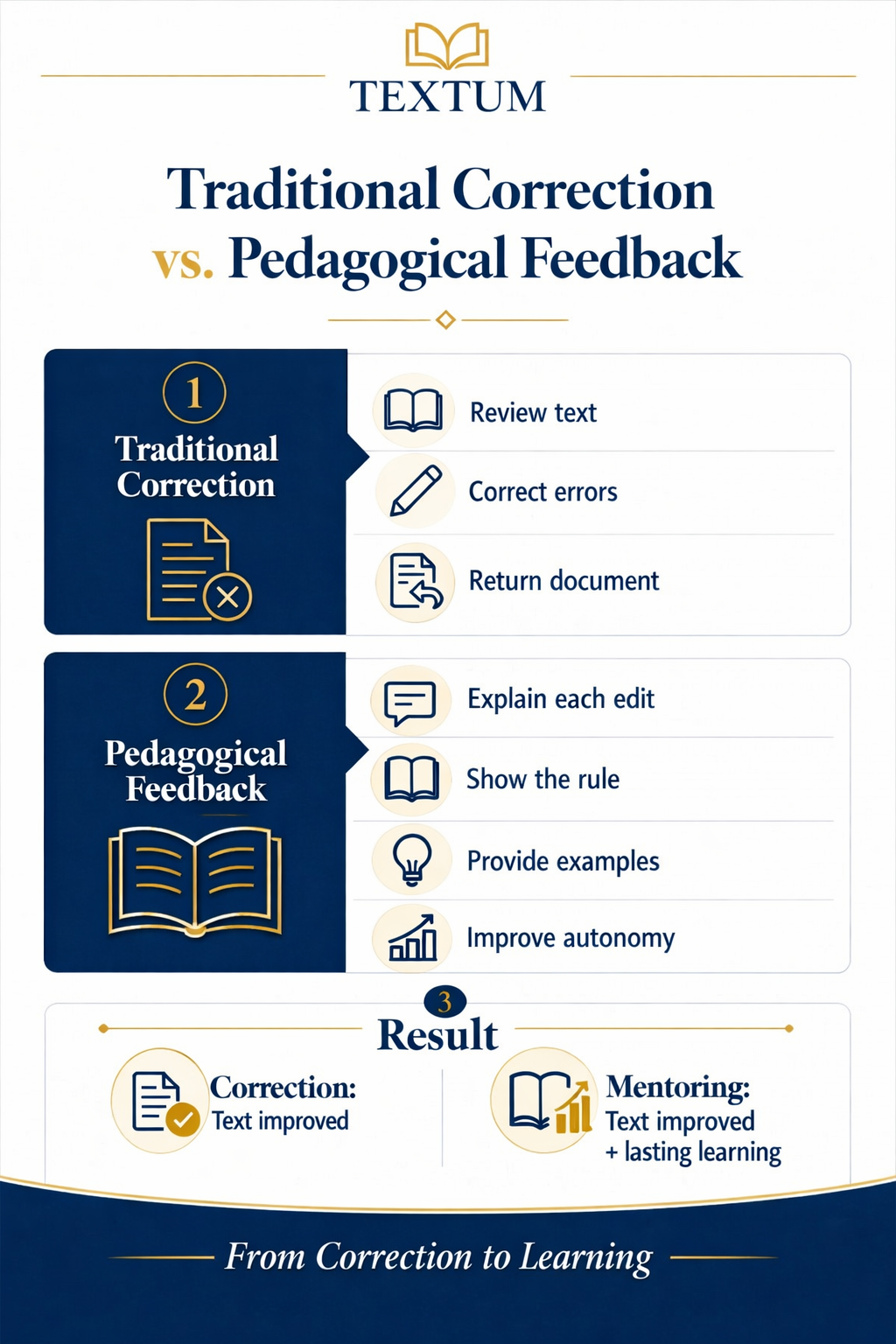
TEXTUM´s DNA. Beyond correction: toward lasting learning
The virtuous cycle of academic learning
Pedagogical feedback activates a chain of intellectual growth that unfolds in five continuous stages:
[Initial Error] ➔ [Didactic Explanation] ➔ [Rule Understanding] ➔ [Practical Application] ➔ [Knowledge Consolidation]
If you remove the explanation, the cycle breaks entirely and the error stagnates, preventing your development as a researcher.
Feedback as an act of professional respect
When a service returns a corrected file without comments, it places you in the role of a passive client under the premise: “You pay, I fix it, and don’t worry about understanding.”
A mentor, however, takes the time to justify each linguistic or structural change. They recognize you as an author in training. There is genuine trust in your ability to learn, refine your style, and achieve academic excellence on your own.
At TEXTUM, we don’t just correct — we teach
Every manuscript processed on our platform is delivered with a personalized pedagogical report. We explain the logic behind substantive modifications, map your recurring areas for improvement, and provide interactive resources to strengthen your writing.
Because true success is not just a perfectly formatted digital file; it lies in forming a professional who writes with increasing clarity and confidence.
Our guiding principle says it best:
“From correction to learning.”
We invite you to take the first step toward scientific autonomy by booking a free 15‑minute diagnostic session.
👉 Reserve your free 15‑minute consultation here.