
Does Your Theoretical Framework Guide Your Research—Or Just Cite Authors?
Five Methodological Decisions for Building a Meaningful Theoretical Framework
By Vilma María Pérez Viñas. TEXTUM · Mentoría Académica
Introduction
For many researchers, the theoretical framework is often the longest chapter of a thesis or research project. Weeks, and sometimes months, are devoted to reviewing books, journal articles, and previous studies in the hope of providing a solid foundation for the investigation.
Yet, once the chapter is complete, an important question often remains unanswered:
Does the theoretical framework genuinely support the research, or has it simply become a collection of definitions and references?
It is common to find theoretical frameworks filled with concepts, quotations, and scholarly citations that are academically sound but contribute little to explaining the research problem or supporting the methodological decisions that follow.
From the TEXTUM Perspective, the purpose of a theoretical framework is not to demonstrate how extensively a researcher has read. Its real function is to organize the body of knowledge required to understand the object of research, provide the conceptual foundation for the research problem, and guide the methodological decisions that ensure coherence throughout the entire investigation.
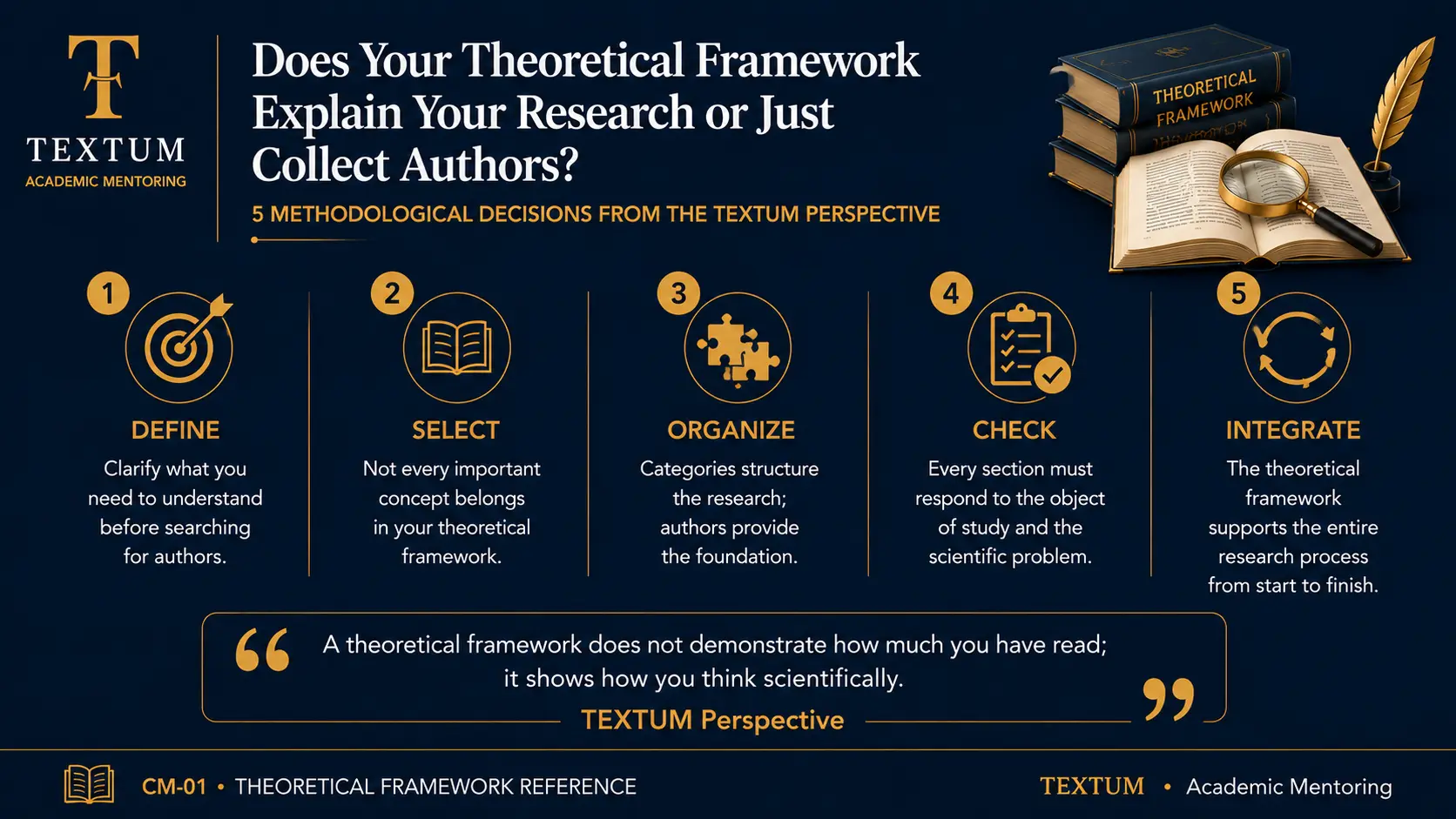
The five methodological decisions presented below will help you evaluate whether your theoretical framework is truly fulfilling that purpose.
Decision 1
Start with the Object of Research, Not with the Authors
One of the most common misconceptions is to begin a theoretical framework by collecting definitions from different authors.
Although defining concepts is important, it should never be the starting point.
From the TEXTUM Perspective, the theoretical framework should emerge from the object of research. The concepts included, and the way they are organized, must help explain the phenomenon under investigation rather than simply demonstrate familiarity with the literature.
The object of research provides the methodological focus that determines what knowledge is relevant and what can be left aside.
Without that focus, the theoretical framework can easily become a catalogue of concepts instead of an intellectual structure that supports the research.
Here is an example:
Suppose a study investigates the development of reading comprehension among secondary school students.
Many researchers begin by defining:
· Education
· Learning
· Pedagogy
· Constructivism
· Educational Technology
Although each concept is academically legitimate, an important methodological question remains:
Do these concepts explain the object of research?
If the answer is no, they do not belong, at least not in the way they have been incorporated.
The TEXTUM Perspective
A theoretical framework should not begin with the question:
"Which authors should I cite?"
It should begin with a much more important methodological question:
"What knowledge do I need to understand my object of research?"
This shift changes the entire logic of the chapter.
The framework is no longer organized around authors. It is organized around the knowledge required to understand the phenomenon being investigated.
Decision 2
Select Concepts with a Methodological Purpose
Once the object of research has been clearly defined, the next methodological decision concerns the concepts that will form the theoretical framework.
Researchers often assume that the more concepts they include, the stronger the framework becomes. The opposite is frequently true.
A theoretical framework gains strength not from the number of concepts it contains, but from the methodological function each concept performs.
Every concept should answer a simple question:
Why is this concept necessary to understand my object of research?
If no clear methodological justification exists, the concept is probably unnecessary.
This does not mean that important theories should be excluded. It means they should only be incorporated when they contribute directly to explaining the phenomenon under investigation or support subsequent methodological decisions.
A theoretical framework is not a repository of knowledge.
It is a carefully constructed intellectual architecture in which every element serves a specific purpose.
Here is an example:
Imagine a study exploring students' academic motivation in online learning environments.
The researcher includes extensive discussions of:
· Humanistic Education
· Critical Pedagogy
· Educational Leadership
· Learning Communities
· Motivation Theory
· Self-Determination Theory
Although each topic is academically valuable, only some may contribute to explaining the research object.
The methodological question is not whether these theories are important.
The real question is whether they are necessary.
Only those concepts that help explain academic motivation within online learning should become part of the framework.
Everything else, however interesting, risks distracting from the central purpose of the research.
The TEXTUM Perspective
A concept deserves a place in the theoretical framework only if it performs a methodological function.
Its inclusion should never be justified merely because it appears frequently in the literature, because it belongs to a well-known author, or because previous studies have cited it extensively.
In the TEXTUM approach, concepts are selected for their explanatory power, their relationship to the object of research, and their contribution to methodological coherence.
A concise and purposeful framework is almost always stronger than one overloaded with information. Knowledge becomes valuable only when it helps explain the research problem.
Decision 3
Build Relationships, Not Lists
One of the clearest signs of a weak theoretical framework is that it reads like a sequence of independent definitions.
One concept follows another.
One author follows another.
One theory follows another.
Yet the reader never discovers how these ideas relate to one another or why they have been presented in that order.
Research, however, is built on relationships.
A theoretical framework should therefore reveal how concepts interact, complement one another, or even challenge one another in explaining the phenomenon under investigation.
Concepts are not isolated pieces of information.
They form a system of knowledge.
The researcher's responsibility is to make that system visible.
Here is an example:
A study on digital literacy may discuss digital competence, information literacy, critical thinking, media literacy, and lifelong learning.
Presenting definitions of each concept separately provides information.
Explaining how these concepts interact to support digital literacy provides understanding.
That difference transforms a descriptive chapter into an analytical one.
The TEXTUM Perspective
The value of a theoretical framework lies not only in the quality of the concepts it contains, but in the quality of the relationships established among them.
Knowledge becomes scientifically meaningful when connections are made explicit. Theoretical coherence emerges from those connections, not from the accumulation of references.
Decision 4
Organize Theory Around the Logic of the Research
Selecting the right concepts is only part of the task.
How those concepts are organized is equally important.
Many theoretical frameworks follow the order in which information was collected rather than the logic of the investigation itself. Concepts appear one after another simply because they were encountered during the literature review, creating a chapter that is informative but methodologically fragmented.
A theoretical framework should not reproduce the history of the researcher's reading.
It should reflect the internal logic of the research.
Each section should prepare the reader for the next. Each concept should create the conditions for understanding the following one. By the end of the chapter, the reader should possess the conceptual foundation necessary to understand the research problem, the methodological design, and the interpretation of the findings.
In other words, the framework should tell a coherent intellectual story.
Not a story about the literature.
A story about the research.
Here is an example:
Consider a study investigating the impact of formative assessment on students' self-regulated learning.
A fragmented framework may begin with educational assessment, move to learning theories, return to motivation, introduce formative assessment, discuss self-regulation, and conclude with feedback.
A coherent framework follows a different path.
It begins with the phenomenon being investigated, develops the theoretical foundations that explain it, introduces the concepts that illuminate the relationships among its components, and concludes with the theoretical perspective that supports the methodological design.
The difference is not the amount of information. It is the organization of knowledge.
The TEXTUM Perspective
The sequence of a theoretical framework is never accidental.
Its structure should mirror the reasoning that guides the investigation.
When theory is organized according to methodological logic, readers can understand not only what the researcher knows, but why that knowledge is essential for the study.
Coherence is built through sequence.
A well-organized framework allows every concept to prepare the way for the next, creating a continuous line of reasoning from the research problem to the methodological decisions that follow.
Decision 5
Let the Theoretical Framework Guide the Entire Investigation
Perhaps the most important methodological decision is also the one most frequently overlooked.
A theoretical framework is not written simply to satisfy the structure of a thesis or research report.
Its purpose does not end when the chapter is completed.
It should accompany the entire investigation.
The concepts, theories, and relationships established in the framework should guide the formulation of research questions, the selection of methods, the construction of instruments, the interpretation of findings, and the discussion of results.
When this continuity is absent, methodological coherence begins to disappear.
The theoretical framework becomes disconnected from the rest of the investigation, functioning as an isolated chapter rather than as the conceptual foundation of the research.
Theory should remain present from the first methodological decision to the conclusion.
Only then does it fulfill its true scientific purpose.
Here is an example:
Imagine a researcher who defines collaborative learning extensively in the theoretical framework but later designs instruments that measure only individual performance.
The concepts and the methodology no longer speak the same language.
The inconsistency is not merely theoretical.
It affects the validity of the investigation itself.
A coherent study ensures that every methodological decision can be traced back to the conceptual foundations established in the theoretical framework.
The TEXTUM Perspective
A theoretical framework is not a chapter. It is the conceptual thread that connects every stage of the investigation.
When theory genuinely guides methodological decisions, coherence emerges naturally throughout the research process.
The strongest theoretical frameworks are not those that contain the greatest number of references. They are the ones that remain visible from the opening pages of the study to its final conclusions.
Final Reflection
The quality of a theoretical framework cannot be measured by its length, the number of authors it cites, or the volume of literature it reviews.
Its quality depends on something far more important:
- Whether it helps the researcher understand the object of research.
- Whether it provides the conceptual foundation for methodological decisions.
- Whether it contributes to the coherence of the investigation.
A theoretical framework fulfills its purpose when it becomes an active instrument of scientific reasoning rather than a passive compilation of academic sources.
- Every concept should explain.
- Every section should connect.
- Every theoretical decision should strengthen the integrity of the research.
That is what transforms a theoretical framework into a genuine methodological foundation.
The TEXTUM Reflection
From the TEXTUM Perspective, methodological coherence does not emerge at the end of a research project.
It is constructed from the very beginning, one well-founded decision at a time.
The theoretical framework is one of the first opportunities to make that coherence visible.
It is where researchers move beyond collecting knowledge and begin to organize it with purpose.
Because theory is not the destination of research. It is the structure that allows research to move forward.