
What Makes a Research Question Truly Scientific?
From a Research Topic to a Scientifically Constructed Question
By Vilma María Pérez Viñas. TEXTUM. International Academic Mentoring
Every research project begins with something that sparks interest: a situation, an experience, a professional difficulty, a theoretical discussion, or a phenomenon that appears to require further understanding. Yet this starting point does not in itself constitute a research question.
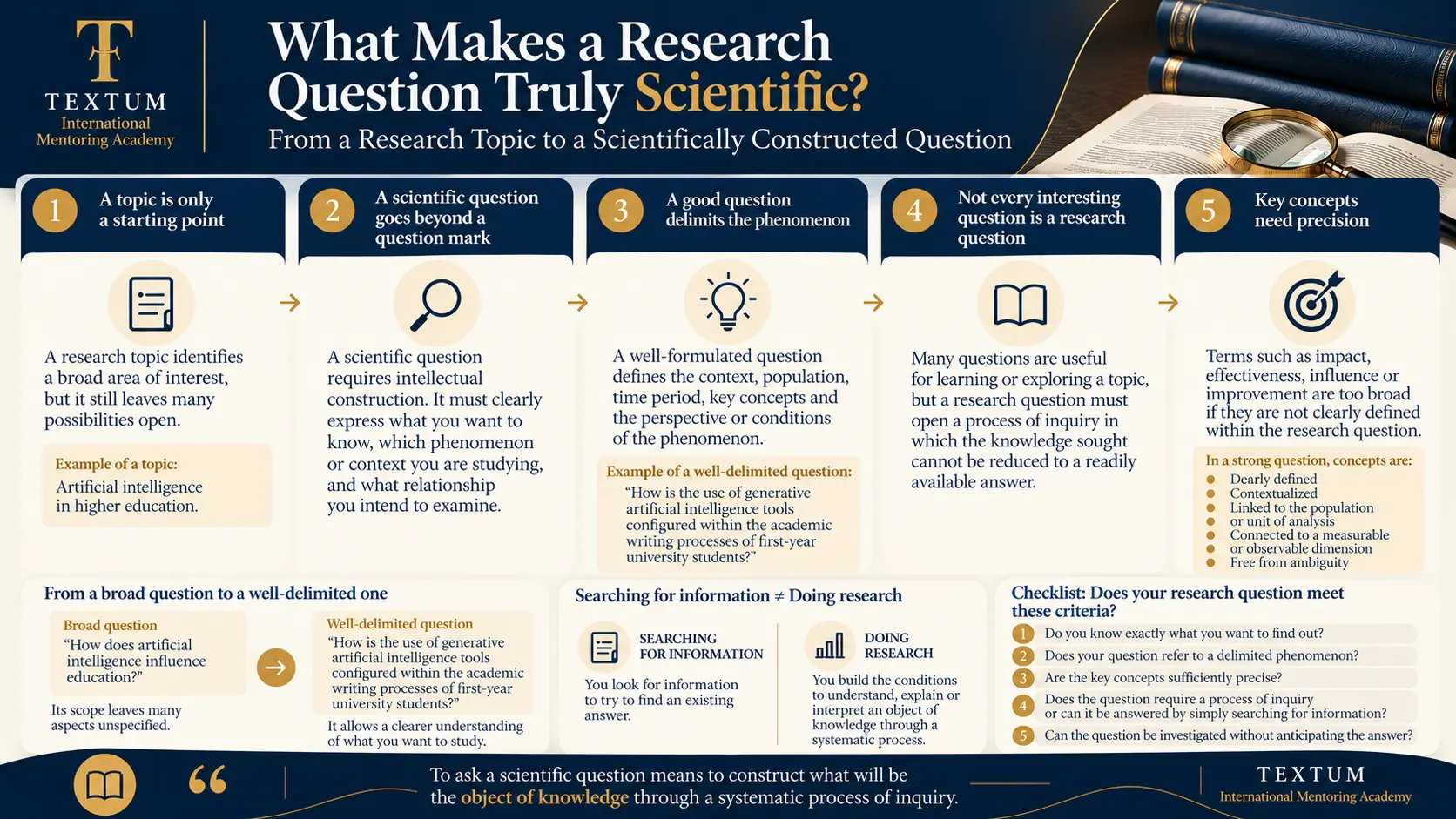
Nor is it enough to turn a statement into an interrogative sentence. To ask a scientific question means to construct what will become the object of inquiry through a systematic process of investigation.
This distinction often goes unnoticed. A question may be grammatically correct, interesting, and even appear academic, while still failing to express precisely what one seeks to know.
Therefore, before asking whether your research question is well written, it is worth posing a deeper question: what makes a question truly scientific?
A Research Topic Is Not Yet a Scientific Question
A research topic identifies a field of interest. It may concern, for example, artificial intelligence in education, teacher education, scientific writing, language learning, or university assessment.
But a topic still leaves too many possibilities open.
Saying that a study addresses artificial intelligence in higher education does not make clear which aspect of the phenomenon is to be understood, from what perspective, or which relationship or situation will constitute the object of inquiry.
A scientific question emerges when this broad field begins to be configured as a delimited object of knowledge.
Moving from a topic to a question, therefore, is not simply a matter of reducing the number of words. It involves making decisions about what is worth knowing within the selected field.
Asking Scientifically Means Constructing What You Want to Know
A scientific question is not defined simply by ending with a question mark.
Its scientific character depends on what it enables us to construct intellectually.
When a question is scientifically formulated, it allows us to identify what we want to know, which phenomenon or situation is being investigated, and what kind of relationship with that object is to be examined.
Consider the difference:
How does artificial intelligence influence education?
The question appears academic, but its breadth leaves numerous aspects unspecified: Which artificial intelligence? Which dimension of education? In what context? For whom? What does “influence” mean?
A more delimited formulation might be:
How is the use of generative artificial intelligence tools configured within the academic writing processes of first-year university students?
The second question is not necessarily better because it is longer. It is more precise because it makes clearer what phenomenon is to be studied and within what specific configuration.
Scientific precision, therefore, does not consist of adding information to a question, but of adequately constructing what will become the object of knowledge.
Not Every Interesting Question Is a Research Question
In academic life, we constantly formulate questions:
What is generative artificial intelligence?
When did it begin to be used?
What are its advantages?
Which is the best tool?
How does a particular technology work?
These questions may be useful for learning, exploring a topic, or locating information. A research question, however, involves a different requirement: it must open a process of inquiry in which the knowledge sought cannot be reduced to retrieving an already available answer.
This does not mean that a research question must always address something completely unknown to the scientific community. It means that there must be a need for inquiry that justifies producing, examining, interpreting, or reorganizing knowledge about a situated object.
Here we encounter a fundamental distinction between searching for information and conducting research. Information is searched for to find an answer. Research involves constructing the conditions for understanding, explaining, or interpreting an object of knowledge through a systematic process.
The Concepts in the Question Also Require Precision
A frequent problem in formulating research questions is the use of concepts that are too broad.
Words such as impact, importance, effectiveness, influence, improvement, or benefits may appear scientific because they are frequently used in academic texts, but they do not in themselves guarantee a researchable question.
The problem is not using these terms but using them without specifying what they mean within the study.
For example:
What impact does technology have on learning?
What technology? What learning? In which population? What will be understood as impact? How will it be identified?
A scientifically constructed question requires its central concepts to acquire a sufficiently precise meaning within the study.
Formulating the question therefore also requires conceptual thinking. Before choosing particular terms, it is worth asking what reality they designate and what relationship they establish with one another.
Conceptual precision is not merely a terminological matter. It determines which phenomenon is made visible to the research process.
Delimiting Does Not Mean Narrowing the Question
A common misconception is that a question is better when it is broader because it allows more aspects of a phenomenon to be addressed.
In research, the opposite is often true.
An excessively broad question may contain many possibilities, but precisely for that reason it may be difficult to turn into a concrete inquiry.
Delimiting means establishing the conditions that make it possible to recognize which part of the phenomenon will be studied.
Depending on the research, delimitation may involve:
A context;
A population or group;
A period;
A dimension of the phenomenon;
A relationship between categories;
A specific situation;
A theoretical perspective;
A particular condition.
A question does not lose depth when it is delimited. It gains capacity for inquiry.
Rigorous research does not need to encompass an entire phenomenon in order to produce relevant knowledge. It needs to construct precisely the segment of the phenomenon it proposes to study.
A Question Should Open an Inquiry, Not Anticipate the Answer
Another important issue arises when the formulation contains in advance the conclusion that the research is supposedly expected to produce.
For example:
How does the use of artificial intelligence improve learning?
The formulation presupposes that artificial intelligence improves learning. The research is therefore conditioned by a claim that should still be examined.
A more open question might be:
What changes can be observed in the academic writing strategies of university students who use generative artificial intelligence tools while producing written texts?
The difference is not merely linguistic. In the second formulation, the relationship between the phenomenon and its possible effects remains open to inquiry.
A scientific question should allow research findings to emerge through the research process, rather than having the answer already embedded in the formulation.
The Question Reveals a Way of Thinking About the Object
A research question also makes visible how you are thinking about what you want to study.
When you ask about a relationship, a configuration, an experience, a process, a perception, a transformation, or an explanation, you are not simply using different ways of phrasing the same idea. You are constructing different ways of approaching the object.
For this reason, reviewing a research question is not simply a matter of checking its grammar.
It also involves asking:
What phenomenon am I constructing as an object of knowledge?
Which concepts do I need to distinguish to formulate it?
What relationship am I establishing between these concepts?
Which part of the phenomenon falls within the question, and which part falls outside it?
Does the formulation leave open the possibility of finding results different from those I initially expected?
Does the question express a genuine need for inquiry?
These questions allow us to move from formal correctness to a properly methodological review.
In this sense, a question does not merely express what we want to investigate. It also reveals the conceptual decisions through which we are constructing what will be investigated.
A Question Must Be Methodologically Researchable
A question may be interesting and conceptually precise, but it still needs to pass a fundamental test: can it be investigated rigorously?
Researchability does not mean that there is a single correct way to answer the question. It means that the formulated object allows for concrete possibilities of approaching, producing, and analyzing evidence.
A question centered on the configuration of a practice entails different requirements from one centered on the relationship between two variables or on the experience of particular participants.
The review of a question should therefore consider the correspondence between what one seeks to know, the object that has been constructed, and the actual possibilities for inquiry.
This examination helps identify questions that appear solid at the discursive level but present difficulties when one attempts to translate them into a concrete research process.
Five Questions for Reviewing Your Research Question
Before moving on to the objectives or to the construction of the theoretical framework, you can subject your question to a critical review:
1. Do I know exactly what I want to know?
If the answer still requires too much explanation, the object may not yet be sufficiently configured.
2. Does my question refer to a delimited phenomenon?
An overly broad question may make it difficult to construct a concrete inquiry.
3. Are the central concepts sufficiently precise?
The terms used should represent what you actually intend to study.
4. Does answering the question require research, or could the answer simply be obtained by searching for information?
This distinction helps identify whether there is a genuine need for inquiry.
5. Can the question be investigated without anticipating its answer?
Research needs room for evidence and analysis to contribute to the construction of knowledge.
If any of these questions raises doubts, the problem may not yet lie in the wording. It may lie in the methodological construction of the research object.
TEXTUM Perspective
At TEXTUM, we understand the research question as a decision that shapes the object of inquiry.
Constructing it requires moving from an initial interest in a topic toward a sufficiently delimited, conceptually precise, and researchable representation of what is to be investigated.
For this reason, a scientific research question should not be evaluated solely by its interrogative form or by the presence of academic-sounding terms. It should be evaluated by the quality of the decisions it embodies.
To ask scientifically means deciding what is worth knowing, how the object of inquiry is to be configured, and under what conditions it can be investigated.
This perspective helps explain why some methodological problems emerge before researchers begin writing chapters, selecting instruments, or formulating objectives: the problem may lie in a research question that has not yet been sufficiently thought through.
A research question is not the final stage of good academic writing. It is an intellectual construction that makes visible what the research seeks to understand.
Do you need to review the methodological architecture of your research?
A research question may be correctly worded and still require a deeper review of its methodological construction.
At TEXTUM. International Mentoring Academy, we work with the decisions that shape a research project to promote greater conceptual precision, methodological rigor, and autonomy throughout the academic process.
[REVIEW MY RESEARCH QUESTION]
Continue the journey
Do you now have a clear research question?
The next step is to determine whether your research objectives actually express the direction that question requires.
→ When the General and Specific Objectives Tell Different Stories