The Integral Research Approach (IRA): An Integral, Articulated and Recursive Conception of Scientific Research
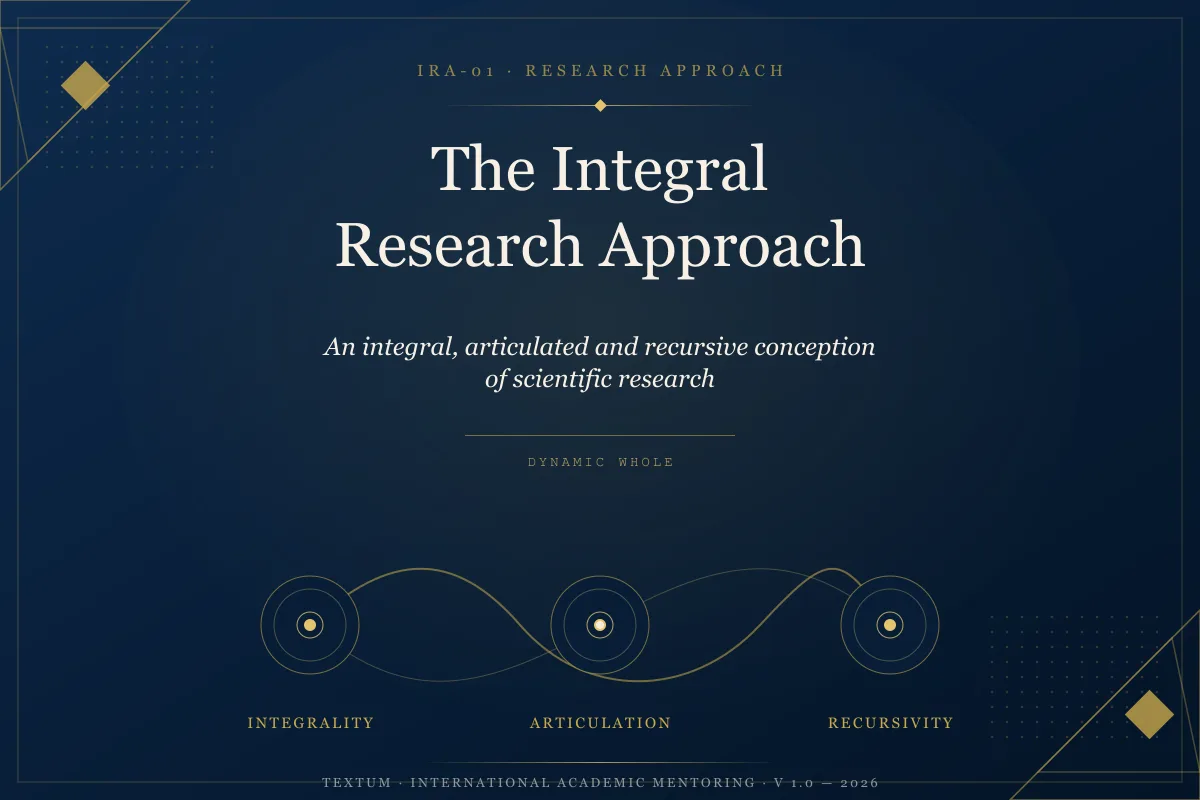
The IRA understands research as a dynamic whole in which components, relationships, and decisions acquire meaning through their articulation and through the dynamics of the knowledge-construction process.
The Integral Research Approach (IRA): An Integral, Articulated and Recursive Conception of Scientific Research
Authors: Yadyra de la Caridad Piñera Concepción
Vilma María Pérez Viñas
TEXTUM. International Academic Mentoring
V 1.0 — September 2026
Editorial Card — Integral Research Approach (IRA)
Collection: Thinking Methodologically about scientific resarch
Title: The Integral Research Approach (IRA): An Integral, Articulated and Recursive Conception of Scientific Research
Nature: Conceptual article
Version: 1.0
Year: 2026
Purpose: To conceptually ground the IRA as a differentiated conception of scientific research.
Central conception: The IRA understands research as a dynamic whole in which components, relationships, and decisions acquire meaning through their articulation and through the dynamics of the knowledge-construction process.
Conceptual architecture: Dimensions, principles, and categories related configurationally across different levels of conceptual abstraction.
Dimensions: Integrality · Articulation · Recursivity
Principles: Functional interdependence · Methodological correspondence · Recursivity
Analytical categories: Research configuration · Methodological pertinence · Research reconfiguration
Transversal criterion: Methodological coherence
Methodological position: The IRA uses quantitative, qualitative, documentary, experimental, interpretive, and other methods according to research demands. It is not defined by methods and is not equivalent to mixed methods.
Contribution: Provides a conceptual and relational architecture for understanding and analyzing research configuration, the relationships among its decisions, and the transformations that may occur during knowledge construction.
Abstract
Scientific research involves components, relationships, and decisions that participate in the construction of knowledge. When these elements are addressed in isolation, it becomes difficult to understand the relationships that articulate them and the transformations that may occur throughout the research process.
This article aims to conceptually ground the Integral Research Approach (IRA) as a differentiated conception of scientific research. The IRA understands research as a dynamic whole, in which components, relationships, and decisions acquire meaning through their articulation and through the dynamics of the knowledge-construction process.
The approach is structured around three dimensions —integrality, articulation, and recursivity—, three principles —functional interdependence, methodological correspondence, and recursivity—, and three categories —research configuration, methodological pertinence, and research reconfiguration— related across different levels of conceptual abstraction.
Methodological coherence is established as a transversal criterion. It is understood not as the preservation of initial decisions, but as the correspondence of relationships and decisions with the logic of knowledge construction, including when the research needs to transform. Recursivity makes it possible to understand that knowledge produced during the research itself may generate new understandings that lead to reconsideration and, when necessary, reconfiguration.
The contribution of the IRA consists of a conceptual and relational architecture for understanding and analyzing research as a whole, the relationships that articulate its decisions, the pertinence of those decisions, and the transformations that may occur during knowledge construction.
Keywords: Integral Research Approach; scientific research; conceptual and relational architecture; dynamic whole; methodological coherence; recursivity.
Introduction
Scientific research involves components, relationships, and decisions that make it possible to delimit what is to be known, how that knowledge will be constructed, and what results may be obtained. However, when these elements are organized and analyzed in a fragmented manner, the relationships they maintain with one another and their function within the research as a whole may be overlooked.
This fragmentation makes it difficult to understand why a decision that is initially pertinent may lose its adequacy as research progresses, why modifying one component may affect other elements, or why the quality of research does not depend exclusively on the individual correctness of its components.
It is therefore necessary to consider research not only as a structure composed of differentiated elements, but as a whole in which functional relationships exist and new meanings may emerge during the process of knowledge construction.
The Integral Research Approach (IRA) is proposed as a conception of research oriented toward understanding it from this perspective. Its conceptual and relational architecture makes it possible to understand how research is configured, how its elements are articulated, and how it may, when necessary, be reconfigured.
From this conception, the issue is not to establish a new sequence of stages or to determine a specific combination of methods. Rather, it is to provide a conceptual basis for understanding research as a whole and for analyzing the relationships that make its coherence possible.
Accordingly, this article addresses three fundamental questions:
What is the IRA?
How is it conceptually structured?
What does it contribute to the understanding and analysis of scientific research?
The Integral Research Approach as a Research Conception
The Integral Research Approach constitutes a differentiated conception of scientific research that understands research as a whole. From this perspective, components, relationships, and decisions acquire meaning through the articulation they maintain with one another and through the dynamics of the knowledge-construction process.
Research is not conceived as a static sum of parts. A set of correctly formulated components does not, by itself, guarantee the coherence of the research process. Each element acquires a particular function and meaning through the relationships it establishes with the others and through the overall logic of the research.
This conception is expressed through a conceptual and relational architecture composed of dimensions, principles, and categories that make it possible to understand different levels of abstraction within research.
The IRA understands research as integral, articulated, and recursive. These three characteristics constitute fundamental dimensions of the conception.
The IRA is not defined by methods. It may use quantitative, qualitative, documentary, experimental, interpretive, or other methods according to the demands of the knowledge to be constructed and the relationships that configure the research.
In this sense, the IRA uses methods; it is not defined by them.
Nor does it constitute a particular methodology or establish closed procedures. It does not prescribe a single research sequence or a predetermined combination of methods.
Its specificity lies in understanding research as a dynamic whole and in providing a conceptual and relational architecture for analyzing how research is configured, how it is articulated, and how it may transform during knowledge construction.
Research Methods and the IRA
The IRA does not define research through the methods it employs. Quantitative, qualitative, documentary, experimental, interpretive, and other methods may be used according to the requirements of the research and the knowledge to be constructed.
The IRA uses methods; it is not defined by them.
The IRA is therefore not a particular methodology or a closed set of procedures. It does not establish a single sequence of research activities or prescribe a predetermined combination of methods.
Its specificity lies in the conception of research as a dynamic whole and in the conceptual and relational architecture through which that whole can be understood and analyzed.
The Conceptual Architecture of the IRA
The conceptual architecture of the IRA is structured through three dimensions, three principles, and three categories related to one another.
The dimensions express fundamental characteristics of the conception of research.
The principles express regularities through which these characteristics can be understood methodologically.
The categories constitute their conceptual concretization for analyzing research.
The relationship among these elements is configurational. It does not represent a mechanical derivation or an application sequence.
Dimensions
1. Integrality
Integrality understands research as a whole in which components must be considered in relation to the broader research configuration of which they form part.
2. Articulation
Articulation expresses the functional relationships established among components, decisions, and processes. Articulation does not simply mean connecting elements; it means establishing relationships that contribute to knowledge construction and correspond to the logic of the research.
3. Recursivity
Recursivity understands research as an open and dynamic process in which information, analyses, and knowledge produced during the process may generate new understandings and lead to reconsideration of previously established decisions.
Research may therefore transform itself on the basis of the knowledge it produces, without necessarily losing its direction or identity.
These dimensions are interrelated: research constitutes a whole because its components are articulated, while articulation remains open to reconsideration when new understandings emerge during knowledge construction.
Principles and Categories
The configurational relationship among dimensions, principles, and categories can be represented as follows:
Dimension | Principle | Category |
|---|---|---|
Integrality | Functional interdependence | Research configuration |
Articulation | Methodological correspondence | Methodological pertinence |
Recursivity | Recursivity | Research reconfiguration |
This correspondence constitutes a conceptual architecture, not an application route.
Dimension: Integrality,
Principle: Functional Interdependence
Category: Research Configuration
Functional interdependence expresses that decisions, interpretations, and transformations affecting one element of research may affect the function or meaning of other elements.
A modification therefore cannot be assessed exclusively in terms of the element being modified. Its consequences for the research as a whole must also be analyzed.
The category research configuration makes it possible to understand research as the particular organization of functional relationships that articulates its elements. It is not a static sum of components, but a whole configured through relationships.
Dimension: Articulation
Principle: Methodological Correspondence
Category: Methodological Pertinence
Methodological correspondence expresses that methodological decisions should maintain adequate relationships with what the research seeks to know and with the other decisions that constitute its configuration.
Methodological pertinence therefore refers to the adequacy of a decision within a specific research configuration. A decision may be methodologically valid in general terms and nevertheless be insufficiently pertinent within a particular research.
Pertinence depends on its relationship with the research problem, purposes, characteristics of the object, and the other relationships that constitute the research.
Dimension: Recursivity
Principle: Recursivity
Category: Research Reconfiguration
Recursivity has a dual function within the IRA architecture.
As a dimension, it constitutes a characteristic of the research conception: research is open, dynamic, and susceptible to reconsideration.
As a principle, it expresses the methodological regularity according to which knowledge produced during the research itself may generate new understandings that lead to reconsidering previously established decisions, relationships, or meanings.
The category research reconfiguration makes it possible to analyze transformations that may emerge from this recursive dynamic.
Reconfiguration does not necessarily mean modifying the entire research. It may involve transforming components, functions, relationships, interpretations, or meanings when this is necessary to preserve or recover methodological coherence.
The Dynamics of Relationships
Functional interdependence means that the components of research acquire meaning in relation to one another. Any modification should therefore also be assessed according to the consequences it may produce for the whole.
Methodological correspondence makes it possible to assess the functional adequacy of a decision in relation to what is intended to be known and to the other decisions that configure the research. A decision that is methodologically valid in general terms may lose pertinence when incorporated into a specific research configuration.
Recursivity introduces a substantial difference from linear representations of research. Knowledge produced during the process may generate new understandings that lead to reconsidering previously established assumptions.
This may occur, for example, when documentary analysis generates new conceptual delimitations; when the study of the object reveals dimensions that had not been sufficiently considered; when a methodological decision produces information that changes the understanding of the phenomenon; or when the interpretation of results requires previous understandings to be reviewed.
Recursivity does not mean an absence of direction or the permanent modification of decisions. It means recognizing that knowledge construction may create conditions for reconsidering the research configuration itself.
Research reconfiguration is not a subsequent stage or a mandatory operation. It emerges when reconsideration of what has been constructed during the research makes it necessary to modify an element, function, relationship, interpretation, or meaning.
Research may transform without losing its identity or direction, provided that these transformations maintain or make it possible to recover methodological coherence.
Methodological Coherence as a Transversal Criterion
Methodological coherence constitutes a transversal criterion for assessing the configuration of research.
It is not an additional dimension, principle, or category of the IRA. Its function is to evaluate the adequacy of relationships and decisions in relation to the logic of knowledge construction.
Methodological coherence does not consist in preserving initial decisions at all costs. It consists in maintaining appropriate relationships among decisions and with the logic of knowledge construction as research develops.
In this sense, it is necessary to distinguish between methodological pertinence and methodological coherence.
Methodological pertinence refers to the adequacy of a decision or relationship within a specific research configuration. Methodological coherence refers to the correspondence of the configuration as a whole and to its capacity to maintain or recover that correspondence when research undergoes transformations.
Figure 1. The Integral Research Approach (IRA)
TEXTUM ANALYSIS
Scientific research is often presented through components that must be formulated, related, and developed throughout the process. However, this organization may encourage a fragmented reading when each component is considered mainly from the individual function it performs.
From the perspective of TEXTUM, the fundamental contribution of the IRA lies in shifting attention toward the configuration these components form as a dynamic whole.
This perspective makes it possible to understand that a decision cannot be assessed solely by its isolated correctness. It is necessary to consider the function it performs within the research, the relationships it maintains with other decisions, and the consequences that any transformation may have for the whole.
The IRA architecture makes visible three issues that often remain separate in traditional representations: research as a whole, the relationships that articulate its decisions, and the possibility that knowledge produced during the process may generate new configurations.
From this perspective, methodological quality does not depend only on whether each component has been correctly formulated. It also depends on whether the relationships articulating them are functional and whether transformations experienced by the research can be understood within a logic of knowledge construction.
TEXTUM CRITERION
Scientific research should be evaluated as an integral, articulated, and dynamic configuration, in which the pertinence of each decision depends on the relationships it maintains with the whole and whose transformation requires preserving or recovering methodological coherence.
TEXTUM PROPOSAL
TEXTUM proposes understanding and analyzing scientific research through the relationships that configure its whole, attending to the function of each decision, its pertinence within the research context, and the transformations that may arise from the knowledge produced during the process.
This proposal does not turn the IRA into an application sequence. It offers a way of thinking methodologically about decisions, their relationships, and the transformations that may occur during knowledge construction.
TEXTUM REFLECTION
Understanding research as a dynamic whole changes the way methodological coherence is understood.
Rigorous research does not necessarily have to preserve all its initial decisions or incorporate the greatest possible number of methods or components. Its rigor depends on the well-founded construction of relationships and on the capacity to reconsider them when the construction of knowledge itself provides reasons to do so.
From this perspective, change does not in itself constitute a loss of coherence. What matters is understanding why the research changes, which relationships are modified, and how those modifications are integrated into knowledge construction.
Implications for Understanding and Analyzing Research
The main usefulness of the IRA lies in providing a conceptual and relational basis for analyzing research as a dynamic configuration.
This means moving beyond an assessment focused exclusively on the formal presence of components or on compliance with isolated requirements, in order to examine the relationships that articulate the research.
From this perspective, it is possible to analyze:
how research is configured and which functional relationships articulate its elements;
the function performed by each decision within the configuration;
the pertinence of decisions in relation to the problem, object, purposes, and other decisions;
which relational misalignments may exist among components that are formally correct;
how relationships may affect the coherence of the whole;
how a modification arising during knowledge construction may be interpreted.
The recursive conception makes it possible to analyze research as it develops, recognizing that some initial decisions may be reviewed on the basis of the knowledge produced during the process.
The modification of a decision does not automatically constitute a deviation. Its meaning depends on the relationships it establishes with the research configuration and on its correspondence with the logic of knowledge construction.
The IRA thus makes it possible to understand research as a construction that can be analyzed and, when necessary, reconfigured as it develops.
Methodological Diversity and the IRA
The IRA does not oppose quantitative and qualitative perspectives, nor does it require their integration.
Research may employ one or several methods according to the demands of the knowledge it seeks to construct and the relationships that are pertinent for doing so.
Integrality does not imply an obligation to use multiple methods. A single method may form part of an integral research configuration when that configuration makes it possible to address the object of study adequately.
Likewise, the use of multiple methods does not by itself guarantee integral research.
The central issue is not the number of methods used, but their function, the relationships they establish, and their contribution to knowledge construction.
This distinction makes it possible to differentiate the IRA from mixed methods approaches. Mixed methods constitute a specific methodological possibility; the IRA constitutes a broader conception for understanding and analyzing research as a dynamic whole.
Final Considerations
The usefulness of the Integral Research Approach lies in offering a conceptual and relational architecture for understanding and analyzing how research is configured, how its decisions are related, and how it may transform during knowledge construction.
Research is not conceived simply as the execution of a previously defined sequence. It involves configuring, developing, and understanding research as a whole while keeping open the possibility of reconsidering it on the basis of what the process itself makes possible to know.
Research does not lose coherence because it changes; it loses coherence when its changes cease to correspond to the logic of knowledge construction.