HT-01. 20 questions to check the methodological coherence of a research project
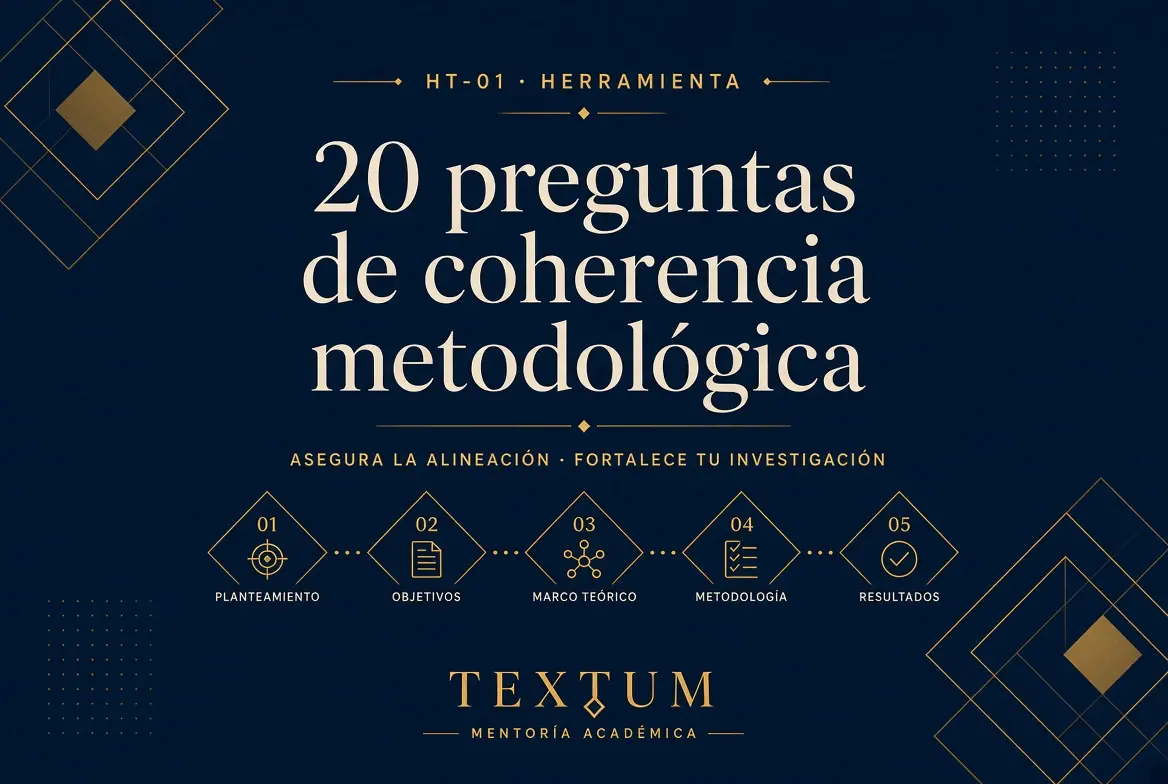
TEXTUM diagnostic tool with 20 questions to assess the internal coherence among problem, objectives, methods, results and conclusions.
TEXTUM COLLECTION
Thinking Methodologically About Scientific Research
HT-01
TEXTUM Tool for Assessing the Internal Coherence of a Research Study
20 Questions to Check the Methodological Coherence of a Research Study
Author: Vilma María Pérez Viñas
TEXTUM. International Academic Mentoring
Version 1.0 — August 2026
Tool Profile
Code: HT-01
Type: Diagnostic Tool
Purpose: To assess the methodological coherence of a research study.
Associated Principle: PT-01. The Scientific Problem Guides the Entire Research Process.
Outcome: Identification of methodological strengths and inconsistencies.
Most methodological problems do not arise from a lack of knowledge about research methods.
They arise from a loss of coherence among the decisions made throughout the research process.
This tool will help you conduct an initial review of your research before submitting it.
1. The Scientific Problem
- ☐ Yes ☐ No — Does the Scientific Problem express a need for knowledge without anticipating a solution?
- ☐ Yes ☐ No — Is there coherence between the problematic situation and the Scientific Problem?
- ☐ Yes ☐ No — Does the Scientific Problem arise from a clearly identified scientific contradiction?
- ☐ Yes ☐ No — Does the intervention appear only as a possible response and not as part of the Scientific Problem?
- ☐ Yes ☐ No — Does the Scientific Problem guide the rest of the research design?
2. Theoretical Design of the Research
- ☐ Yes ☐ No — Does the general objective respond directly to the Scientific Problem?
- ☐ Yes ☐ No — Do the specific objectives develop the general objective?
- ☐ Yes ☐ No — Do the research questions make it possible to address the Scientific Problem?
- ☐ Yes ☐ No — When a hypothesis is used, does it correspond to the Scientific Problem and the categories being studied?
- ☐ Yes ☐ No — Do the categories within the theoretical design maintain coherent relationships with one another?
3. Methodological Design
- ☐ Yes ☐ No — Do the selected methods make it possible to address the Scientific Problem?
- ☐ Yes ☐ No — Do the techniques generate the information that is actually needed?
- ☐ Yes ☐ No — Are the research approach and type of research appropriate for addressing the Scientific Problem?
- ☐ Yes ☐ No — Is there coherence among the Scientific Problem, objectives, methods, and results?
- ☐ Yes ☐ No — Are the methodological decisions sufficiently justified?
4. Results
- ☐ Yes ☐ No — Do the results respond to the objectives?
- ☐ Yes ☐ No — Does the interpretation go beyond the simple description of the data?
- ☐ Yes ☐ No — Do the results engage in dialogue with the Theoretical Reference Framework?
- ☐ Yes ☐ No — Does the evidence support the conclusions?
- ☐ Yes ☐ No — Do the results provide evidence that contributes to a deeper understanding of the Scientific Problem?
5. Conclusions
The following questions complete the final assessment of methodological coherence.
- ☐ Do the conclusions respond to the Scientific Problem?
- ☐ Can each conclusion be related to one or more objectives?
- ☐ Do the conclusions derive from the results obtained?
- ☐ Do the conclusions demonstrate fulfillment of the purpose of the research?
- ☐ Is there coherence throughout the entire research process?
Interpretation
18–20 affirmative responses
The research presents a high level of methodological coherence.
14–17 affirmative responses
The research presents an acceptable level of methodological coherence, although specific aspects require adjustment.
Fewer than 14 affirmative responses
The research requires a thorough methodological review to strengthen its internal structure.
TEXTUM Criterion
The quality of research does not depend solely on knowledge of methods and techniques. It depends, above all, on the coherence of the methodological decisions that articulate the entire research process.
Need a Methodological Review?
At TEXTUM, we support researchers, postgraduate students, and thesis supervisors through mentoring processes aimed at strengthening the methodological coherence of their research.
How to Cite This Tool
Pérez Viñas, V. M. (2026). HT-01. 20 Questions to Check the Methodological Coherence of a Research Study. Thinking Methodologically About Scientific Research. TEXTUM. Academic Mentoring. Version 1.0.
About the Collection
This document is part of the collection Thinking Methodologically About Scientific Research, developed by TEXTUM. International Academic Mentoring.
The collection brings together TEXTUM Principles (PT), Methodological Categories (MC), and TEXTUM Tools (HT), designed to strengthen methodological thinking and foster coherence in the design, development, and evaluation of scientific research.
Each document can be consulted independently; however, its greatest value emerges when it is integrated with the other materials in the collection.
Contact: [email protected]
Website: mentoriatextum.com