PT-01. The scientific problem guides the entire research
The scientific problem is not merely the starting point of an investigation: it is the generative category that gives methodological direction, coherence and meaning to the whole research process.
TEXTUM COLLECTION
Thinking Methodologically About Scientific Research
PT-01. The Scientific Problem Guides the Entire Research Process
Author: Vilma María Pérez Viñas
TEXTUM. International Academic Mentoring
Version 1.0 — August 2026
Among the methodological categories that make up scientific research, the scientific problem occupies a fundamental position because it identifies the knowledge need that gives rise to the study and guides the researcher’s subsequent decisions.
However, its importance goes beyond being the starting point of the research process. From the TEXTUM perspective, the scientific problem performs a generative function: it establishes the methodological direction that makes it possible to articulate the research object, objectives, Theoretical Reference Framework, methods, results, and conclusions.
PT-01. The Scientific Problem Guides the Entire Research Process is grounded in this systemic understanding. Its purpose is to explain why formulating the scientific problem is not merely an initial stage of research design, but the foundation that gives meaning and coherence to the entire research process.
1. Why Does the Scientific Problem Occupy a Central Position?
Various authors in research methodology agree that scientific research begins with the identification of a problem whose understanding or transformation justifies the study. Authors such as Kerlinger and Lee (2002), Hernández Sampieri et al. (2014), and Creswell and Creswell (2018) point out that the scientific problem constitutes the starting point of the research process and influences the formulation of objectives, the selection of methods, and the overall organization of the research design.
However, this explanation often remains limited to describing the order in which the different methodological categories appear. The scientific problem is frequently reduced to the first section of a research proposal, as though its function ended once the objectives had been formulated.
From the TEXTUM perspective, this interpretation is insufficient.
The scientific problem occupies a central position not because it appears at the beginning of the theoretical design, but because it constitutes the category that gives direction to the research process.
Its function is not simply to initiate the research, but to maintain the methodological coherence of all decisions made throughout its development.
The research object is delimited in order to understand the reality expressed in the scientific problem; the objectives specify the results needed to respond to that knowledge need; the Theoretical Reference Framework provides the required conceptual grounding; the methodological design selects the most appropriate procedures for producing the necessary knowledge; the results provide the evidence obtained; and the conclusions assess the extent to which the scientific problem has been addressed through scientifically grounded findings.
Consequently, no methodological category possesses absolute independence within the system. Each acquires meaning through the relationship it maintains with the scientific problem.
2. The Scientific Problem as a Generative Category
It is common to state that the scientific problem is the main category of research. However, this expression does not fully capture the function it performs within the methodological system.
From the TEXTUM perspective, it is more precise to understand the scientific problem as a generative category.
A category is generative when it produces the methodological conditions required for constructing the other categories of the research design.
The scientific problem generates the research object by delimiting the area of reality that requires investigation; it generates the objectives by defining the knowledge that must be achieved; it conditions the selection of methods, techniques, and instruments; it guides the organization of the Theoretical Reference Framework; and it provides the criterion through which the findings will be interpreted.
The other categories do not derive from one another independently. They ultimately find their foundation in the scientific problem.
For this reason, a substantial modification of the scientific problem necessarily requires a review of the rest of the methodological design.
3. What Happens When the Scientific Problem Is Poorly Formulated?
Errors made when formulating the scientific problem do not remain isolated. They progressively spread through the rest of the methodological design, affecting the internal coherence of the entire research.
When the problem is ambiguous, the objectives will be ambiguous as well.
When it anticipates the solution it is intended to demonstrate, the methodological design loses objectivity and tends to justify an answer that has already been assumed.
When it does not express a genuine scientific contradiction, the Theoretical Reference Framework loses its direction and becomes a disconnected compilation of information.
When the focus of the study changes during the research without making the corresponding adjustments, the findings cease to respond to the need originally identified.
Consequently, many of the errors commonly attributed to objectives, Theoretical Reference Frameworks, or methodology originate in an inadequate formulation of the scientific problem.
4. Methodological Directionality
Every research process has a direction. However, that direction does not depend on the chronological order of activities or on following an administrative sequence of stages. It depends on the logical coherence that methodological decisions maintain in relation to the scientific problem.
TEXTUM refers to this property as methodological directionality: the capacity of all categories within the research process to maintain a common orientation toward understanding or transforming the scientific problem.
Methodological directionality makes it possible to understand that objectives are not formulated independently, that the Theoretical Reference Framework is not constructed as a general literature review, and that methodology is not simply a matter of selecting research techniques.
Every methodological decision finds its justification in the scientific problem.
When a category ceases to respond to that problem, the research begins to lose its internal consistency.
One of the most frequent errors is to incorporate, already at the formulation of the problem, the strategy, model, or intervention that the research will later propose. In such cases, the research ceases to be organized around a scientific need and begins to be organized around a previously selected solution.
The intervention is a result of the research process, not its starting point.
5. Methodological Recursivity
Understanding the guiding function of the scientific problem does not mean viewing the research process as a rigid and irreversible sequence of stages.
The production of scientific knowledge is dynamic.
Throughout the research process:
Documentary analysis may lead to a redefinition of the research object.
Conceptual delimitation may make it necessary to reformulate the objectives.
The application of particular methods may reveal dimensions that were not initially anticipated;
Even the interpretation of findings may require a review of the initial understanding of the problem.
TEXTUM refers to this property as methodological recursivity: the capacity to review, adjust, and refine decisions made during the research process without breaking the coherence of the system.
Recursivity is not a methodological weakness.
It is precisely one of the conditions that makes it possible to construct scientifically grounded knowledge.
6. Methodological Coherence as an Emergent Property
Traditional representations often present research as an ordered succession of categories.
This representation facilitates the teaching of research methodology, but it is insufficient to explain how the research process actually operates.
From the TEXTUM perspective, research constitutes a dynamic methodological system.
Within this system, the different categories maintain ongoing relationships of influence and feedback.
Methodological coherence does not mean keeping the initial decisions unchanged.
It means ensuring that all modifications preserve the logical correspondence among the categories that make up the research system.
Methodological directionality provides unity to the process.
Methodological recursivity makes it possible to review and refine the decisions that have been made.
The continuous interaction between these two properties produces a third characteristic of the system:
Methodological coherence.
This coherence does not arise from procedural rigidity, but from the researcher's ability to keep all methodological decisions articulated around the scientific problem as the research evolves.
7. The TEXTUM Model
To synthesize the conceptual relationships developed in the previous sections, Figure 1 presents the TEXTUM Visual Model corresponding to PT-01.
Unlike traditional linear representations of the research process, this model conceives research as a dynamic methodological system organized around the scientific problem as a generative category.
At the core of the model is the scientific problem. Around it, the categories and properties that sustain the unity of the research process are articulated.
The model incorporates:
Methodological directionality, which guides scientific decisions; and
Methodological recursivity, which allows those decisions to be continuously reviewed without losing the coherence of the system.
Together, these properties support the methodological coherence of the research process.
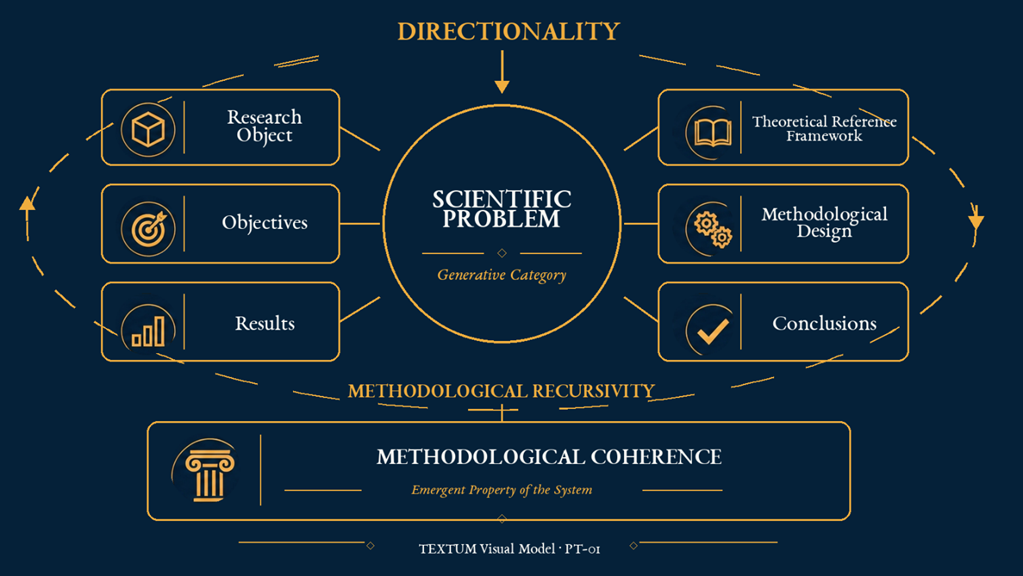
Figure 1. TEXTUM Visual Model of Principle PT-01: The Scientific Problem Guides the Entire Research Process. Source: Author's own elaboration.
TEXTUM ANALYSIS
Research methodology often presents the categories of the theoretical design as necessary components of the scientific project. However, it less frequently explains the relationships they maintain with one another and the logic that preserves their coherence throughout the research process.
From the TEXTUM perspective, the value of research does not depend solely on how well each category has been formulated, but on the consistency of the relationships that articulate them as a dynamic methodological system.
When a decision ceases to respond to the Scientific Problem, methodological directionality begins to deteriorate, and methodological coherence progressively weakens.
TEXTUM CRITERION
The Scientific Problem constitutes the Generative Category of the research system.
From Scientific Problem emerges the Methodological Directionality that guides scientific decisions; through Methodological Recursivity, these decisions can be reviewed, adjusted, and refined throughout the research process, preserving the Methodological Coherence of the system.
TEXTUM REFLECTION
Research does not consist of following a sequence of previously established stages.
It consists of constructing knowledge while maintaining a clear methodological direction, as the research itself requires the continuous review, refinement, and grounding of the decisions made.
A researcher's methodological competence is not demonstrated by the number of methods they know, but by their ability to formulate a Scientific Problem that gives direction, coherence, and meaning to the entire research process.
The Scientific Problem constitutes the Generative Category of the research system. From it emerges the Methodological Directionality that guides scientific decisions; through Methodological Recursivity, those decisions can be reviewed, adjusted, and refined throughout the research process while preserving the Methodological Coherence of the system.
References
Creswell, J. W., & Creswell, J. D. (2018). Research Design: Qualitative, Quantitative, and Mixed Methods Approaches (5th ed.). SAGE Publications.
Hernández Sampieri, R., Fernández Collado, C., & Baptista Lucio, P. (2014). Metodología de la investigación (6.ª ed.). McGraw-Hill Education.
Kerlinger, F. N., & Lee, H. B. (2002). Investigación del comportamiento: Métodos de investigación en ciencias sociales (4.ª ed.). McGraw-Hill.
How to Cite This Principle
Pérez Viñas, V. M. (2026). PT-01. The Scientific Problem Guides the Entire Research Process. Collection: Thinking Methodologically About Scientific Research. TEXTUM. International Academic Mentoring. (Version 1.0, August 2026).
About the Collection
This document is part of the collection Thinking Methodologically About Scientific Research, developed by TEXTUM. International Academic Mentoring.
The collection brings together TEXTUM Principles (PT), Methodological Categories (CM), and TEXTUM Tools (HT), designed to strengthen methodological thinking and promote coherence in the design, development, and evaluation of scientific research.
Each document can be consulted independently; however, its greatest value is achieved when it is integrated with the other materials in the collection.
Contact: [email protected]
Website: https://mentoriatextum.com/